私のCIPは京大の柔道部です。アメリカで、ブラジリアンじゅうじゅつを練習しました。じゃ、ブラジリアンじゅうじゅつと柔道が同じだから、日本で柔道が練習したいです。柔道京都大学の学生と一緒に練習します。京大の学生は全員とても上手です。みなさんは黒帯です。練習は三時間です。難しいけど、とても楽しいです。京大の柔道部でたくさんねわざを練習しています。ねわざが好きだから、京大の柔道部が好きです。京大の柔道家はとてもやさしいです。私は柔道のしゅほうを教えています。学期の終わり時、上手になりたいです。
ジョー・ホルヘ:同志社オーケストラ
実は僕はCIPがまだできていません。本当に悲しいです。KCJSに入った時オーケストラにしたかったです。ですから同志社と京大のオーケストラにE-メールをしましたが二週間ぐらいお返事を待ちました。CIPを始めなくてはいけませんでしたから同志社にオーケストラの人電話をかけました。本当に怖すぎました。でもできました。後で電話をかけたのに、月曜日にオーケストラの練習に行くと皆僕のことが誰か分かりませんでした。とても気まずかったです。オーボエを借りられるのか聞きましたが、借りられないことが分かりました。
最近の水曜日に模型研究会にメールを送つのにまだお返事を待っています。来週の火曜日までに返事をもらえなかったら他のサークルを探すつもりです。
Molly Reissmann: Nikko Nikko : )
For my CIP, I volunteered with the Nikko Nikko Tomato Program at the Kyoto University Hospital. The program organizes fun events for the patients in the ward reserved for terminally ill children age 3 months to 18 years old. One event the program organized was a bazaar. I helped the other volunteers set up an elaborate towel and handkerchief display in preparation for it. I was really impressed with how much time and thought the volunteers put into the displays for the bazaar, as well as how many things had been donated to the program for this event. Since the children’s ward is pretty small and the number of items for sale so large, there were a lot of things left over. The other volunteers and I were then allowed to buy the things we wanted from the bazaar. All the proceeds went to fund Nikko Nikko events.
I think the events the program organizes are great for kids who are unable to leave the hospital. Unfortunately, I did not get to interact as much with the children as I expected I would. However, I was always able to chat with the other volunteers. Besides the 5 KCJS gaijin, the other volunteers were (very sweet) middle-aged Japanese women. They were always interested in hearing about my experience so far in Japan.
While at the hospital, especially during events, I often felt really awkward, like I was getting in the way of the program’s organization. Also, I felt like maybe I sort scared the kids with my height. My only regret is that I was not more outgoing with them. From this experience, I’ve learned that I just need to get over my insecurities with my Japanese speaking ability. I need to take advantage of all these opportunities available while living in Japan and talk to as many Japanese people as possible.
Katrina Vizzini: Kyoto university International eXchange Society (KIXS)
This semester I continued with my participation in KIXS from last semester. The semester began with many events and dinners and many goodbyes. Many of the international friends that I had made the previous semester were on their way home after the Japanese semester ended. It was really bittersweet as I was just starting to become quite good friends with a few of them and then I had to say goodbye. As they’re all in different countries, I am unsure whether I’ll see them again, but we’ve promised to stay in touch via facebook and other online media.
After the semester ended, not only did most of the international students leave, most of the Japanese students went to study abroad or go traveling during break. I had friends in Malta and California, Australia and England. We stayed in contact via facebook, but as far as meeting face to face and participating in a CIP, it was rather difficult. It was also just difficult outside of requirements, in that for a month and a half, the people I had gotten used to seeing everyday were gone. So for a month and a half I mostly hung out with KCJS friends.
Now that the Japanese semester is finally starting up, most of my Japanese friends are back in town and we’ve gotten to hang out a fair amount. It’s been really interesting to hear about their study abroad experiences and hearing them encounter the same difficulties that most KCJS students encounter. With the semester beginning and the sakura blooming, there look to be quite a few events on the horizon, including a hanami event for new students this weekend.
As far as becoming a member of the group, I feel that I’ve made a few fairly large strides towards that goal. At the beginning of the KCJS semester, a large amount of KCJS students were interested in attending KIXS meetings. This can be rather stressful for my friends at KIXS as they now have a large amount of foreign guests that may or may not understand what they should do. I was able to help show people what to do with their food trays and to try and push people away from the KCJS cluster so that they socialize with the other KIXS members. In addition, at the first nomikai of the year, my friend from KIXS was the only Japanese person there and he seemed to be rather stressed out by the daunting task that usually gets left to Japanese people at nomikais: handling everyone’s orders. I stepped in and took on that role for most of the evening and I think I really helped out. In addition to being able to help out instead of play guest, I’ve also been able to hang out with friends from KIXS just to grab lunch or something small, and through that I really feel like I’ve become more of a normal member. Whether this is simply due to the fact that I’ve been there for a while and am no longer the newest member, or if it’s due to the effort I’ve put in, I can’t tell. But, I know that my success in KIXS has definitely been helped by trying to go to all the meetings and events, and trying my best to help out with things. I can’t wait to meet the new students and make new friends this Saturday!
Nathaniel Slottow : Parkour and Taiko
I think the theme for me this semester has been finding my place and reason for being here in Japan. We all come here with a willingness to learn language and culture, see new things, visit new places and meet great people. And of course, everyone has their own share of personal reasons for being here. An amalgam of forces drew me toward the Japanese language and finally over the Pacific Ocean: my neighbor, Totoro, various media (anime, manga, film, video games), my major of computer engineering, an interest in East-Asian martial arts, Japan’s mysterious appeal from an American point of view, my outsider view of the Asian-American community as I was growing up, and my vague uncertainty of my identity as a half Filipino-American. Well, I came, I saw, experienced, and eventually sort of lost sight of why I was here at all.
I think that most of us realize at some point that the encounters and sights that make it into photos don’t necessarily capture the meaning of our time here; the thousand words that a photo gets you are probably not enough to describe the experience of daily life over the course of eight months. Maybe it was thinking about those photo moments, or maybe it was that I noticed that half of us had given up on speaking Japanese to each other, but I realized about six months in that my daily life was lacking societal interaction (not that the thought hadn’t crossed my mind before, but it hit me hard then). While I would participate in an event with Japanese students or groups every week or so, I began to feel that waiting the week out for those events was proof that even though I’d been here for what seems like a solid amount of time, I was still just an ordinary sightseer.
At about the same time, I think that I gave up on trying to blend in. If I’m quiet and I don’t do anything strange, to the unknowing eye, I actually fit right in as a nikkeijin, half-Japanese, or sometimes even according to Wada-san a normal Japanese student. But the problem with fitting in at large on the subway and on the street and at school is that fitting in does not equal societal interaction (I might even venture to say it means the opposite), and fitting in here is not exactly true to my character. The mix of emotions made me very aware of my identity as an American. I wandered around Kyoto, chased cats and buses…
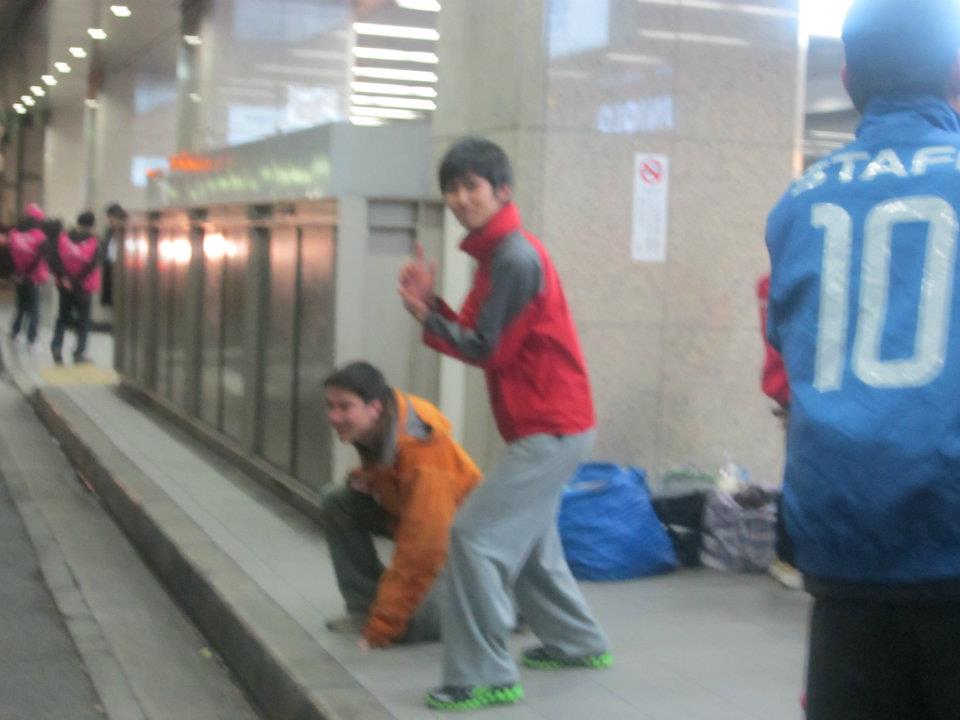
Preparing to see off some KCJSers on their way to Tokyo with Yoshi-kun (courtesy of Andrea Mendoza)
…and planked a little bit.

Vending Machines on the Road to Kameoka (courtesy of Yoshitaro Akiyama)
I started practicing parkour in the Gosho, on the street (not in anyone’s way of course), in my head, basically the same way as I would in the US, but with a renewed energy.
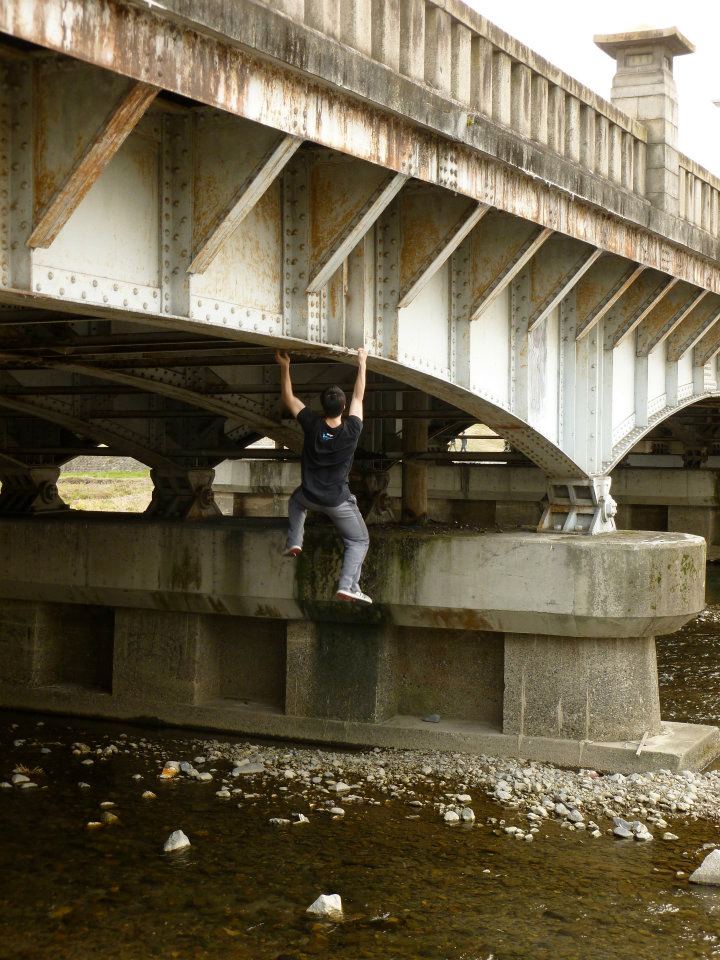
Imadegawa Parkour (courtesy of Lindsay Kosasa)
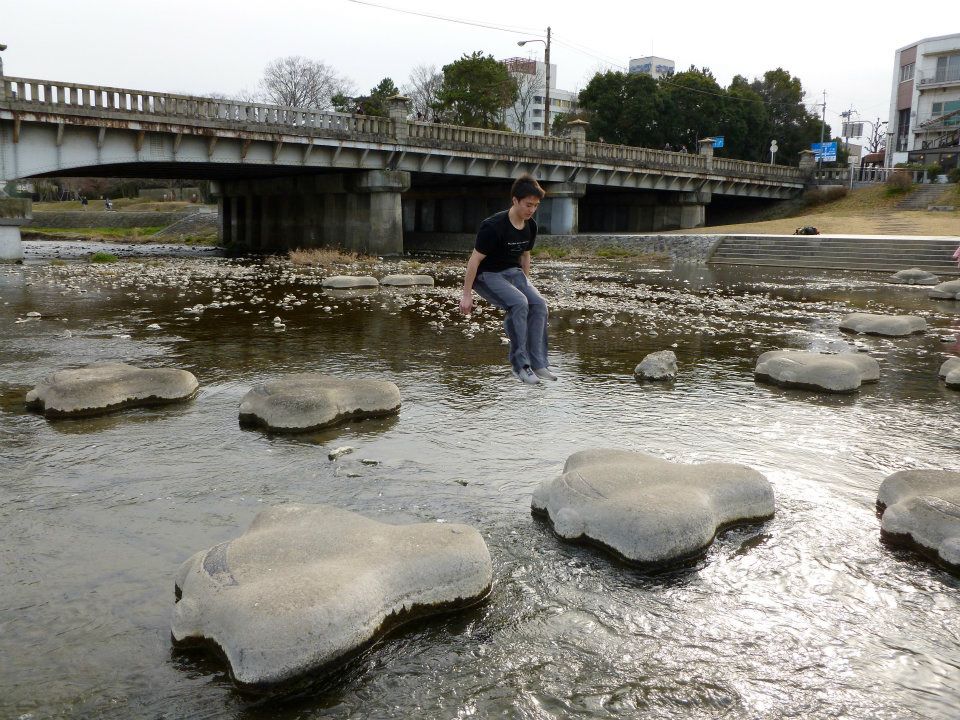
Kamogawa Parkour (courtesy of Lindsay Kosasa)
Don’t worry, I’m getting to the CIP part. Really.
I reminisced about drumline, brainstormed ideas for new pieces for the taiko group, and tried my best to learn as many of the songs as I could for the performance we had last month.
I think those first few days after I gave up on trying to become normal member of Japanese society also made clear how much I love movement, music and the amazingly welcoming groups that make me feel at home doing both here in Japan. Originally, I treated parkour jams and taiko practices as breaks from everyday life in Japan. Though this semester, through instead making those activities part of my daily life even when alone, and also through forcing Fukai-sensei to deal with my existential notebook assignments, I think I was able to find my place in this society. As far as parkour on my own and with the phenomenal Nagare Parkour, that means I became a member of a part of society that is healthy, strong, looking to improve itself, fun-loving, and for some reason doesn’t seem to blend in with the rest of Japan. In the case of the Kitanotenmangu Kamiwakakai Taiko Club (北野天満宮の神若会), I became a member of a family of families and hard working men and women who love people, music and being and playing together. While I don’t know at this point whether I have good reason to return to Japan for an extended period of time, I think I can say that I found a place to be in the groups that I sought out from the start. The goal of the Community Involvement Project (CIP) is to move beyond simply observing society and participate in it. I became a member of society not as a student, and not as someone who can pass as nikkei, but in the sense that I found two groups to belong to that I really love.
Last semester I wrote that I didn’t feel like a true member of the Kitanotenmangu taiko group. Well, that changed. It seems like almost all at once that a couple of the other KCJS students and I started going to dinner along with some members of the group after events sometimes, that it became easier to talk and even joke around a little bit, and that I started to feel like I was not only an exchange student (that was still obvious because we’re not allowed to pay for anything), but a real member of the group. On top of that, we learned new pieces for the performance we had last month, and one of the members who is a carpenter made bachi (taiko drum sticks) and handed them out to everyone. In other words, my first pair of bachi were hand made! The performance turned out to be a lot of fun, even though I was nervous because we sounded really messy at the last practice. The group is more focused on enjoying being and playing together than on playing perfectly, and I’d take that over a super strict group with a perfect sound any day.
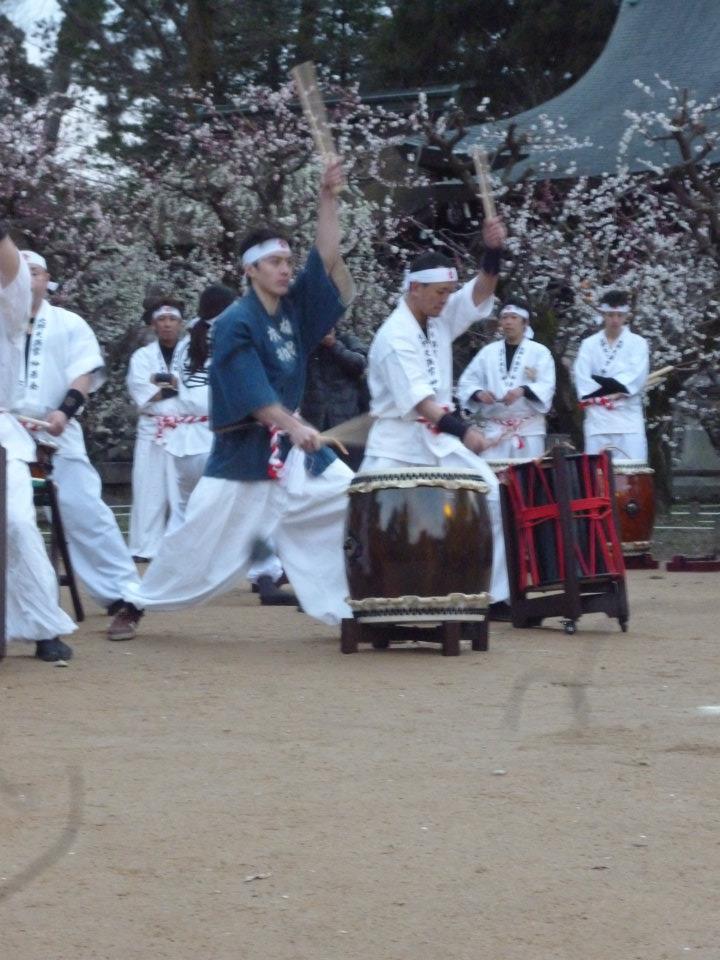
Me! (courtesy of Trisha Martin)
Fukai-sensei, Nishimata-sensei, Shore-san, and a bunch of other KCJS students came out to cheer us on at the performance (thanks guys!). The wonderful Nishimata-sensei was kind enough to take some video:
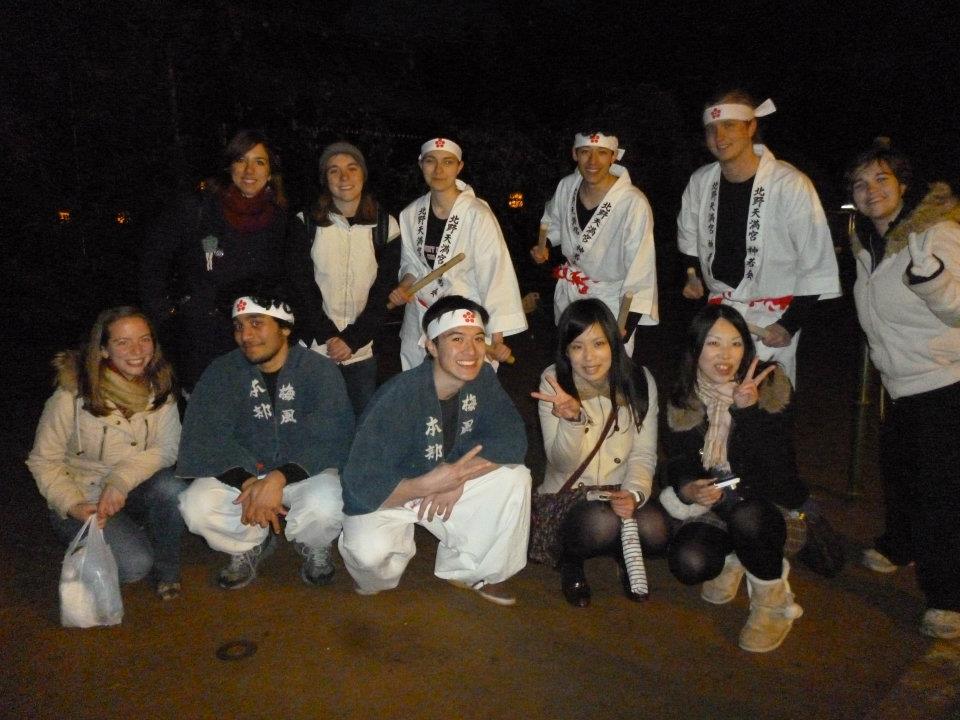
KCJS Group Photo After the Performance (courtesy of Trisha Martin)
Last semester, I wrote that I felt at home training with Nagare Parkour. Even so, I managed to learn some more names, meet more people from all over the place, and get more comfortable speaking with everyone. I also started going out to dinner with a group of members after jams. I might be seeing a pattern here… I do feel like I may focus a little more on the activity than on my relationship with the people overall and that could use some work. But I think that in both parkour and in taiko, I have made real friends that have influenced my life in positive ways. I think that I have been able to at least share common experience with them if not share some knowledge and I plan to keep in touch.
Anyway, one particular day after a post-parkour-jam dinner, everyone decided that they still wanted to train some more. So we began to goof around, took some pictures on a red carpet we found, headed to Shinsaibashi and trained until around 10pm, an unprecedented 9 hours of parkour related activity on a school night. I still had to take the train back to Kyoto so of course I didn’t get any of my schoolwork done (I tend to favor sleep/health over school), but it was worth it. It also just so happens that that day was a special day on which a YouTube project called “Japan in a Day” was taking place, so naturally we took a video to contribute. There’s not much actual parkour in the video, but it gives a sense of the flow and atmosphere of the day from the point of view of my friend, Tak:
3.11 Japan in a Day – “Parkour” (courtesy of Takafumi Kojima)
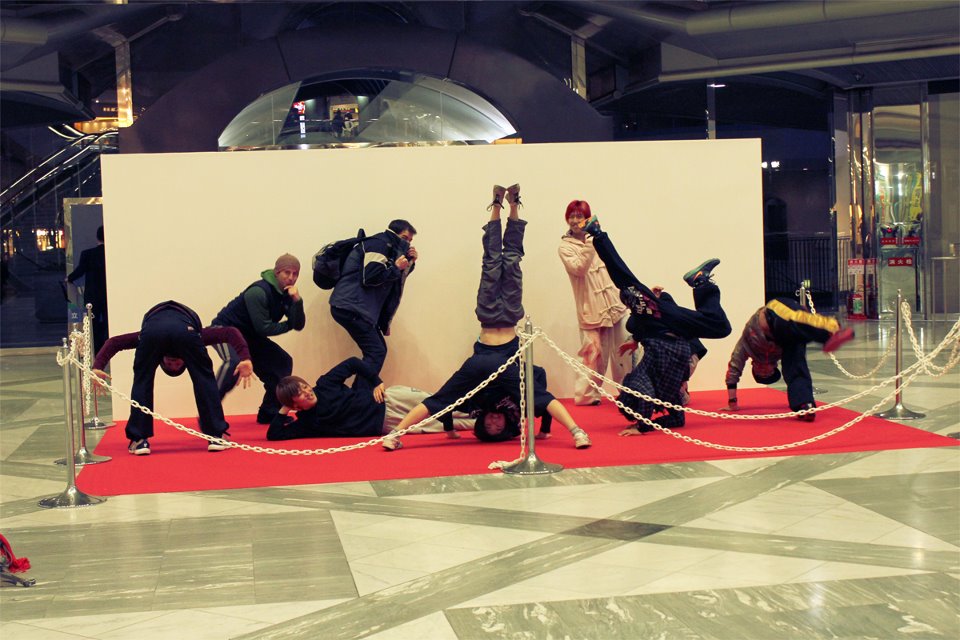
Post-dinner Group Picture (courtesy of Takafumi Kojima)
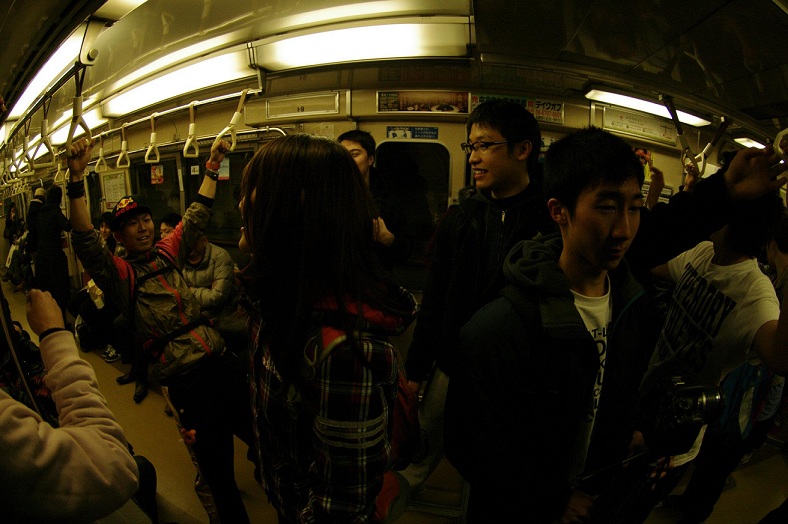
Enroute to Shinsaibashi with Nagare Parkour (courtesy of Bernardo Mayer)
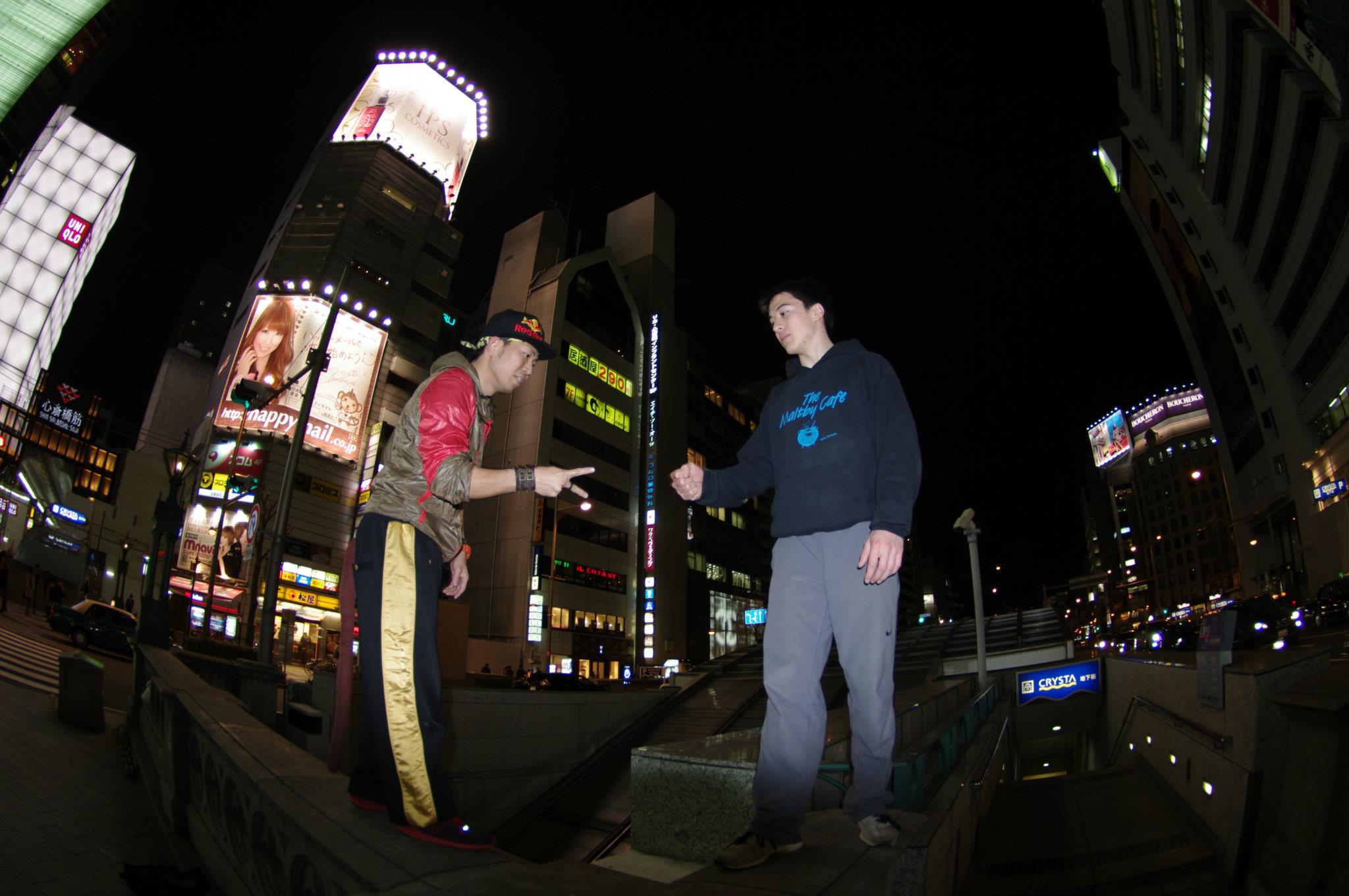
Jyan Ken Pon (courtesy of Bernardo Mayer)
On a more pragmatic note, I think this semester I was able to get more involved in both of my CIP activities not only for the reasons that I mentioned above, but simply because I was more in contact with the members of both groups. I ended up exchanging Facebook information with a couple of members in the taiko group, and a lot of people in the parkour group. I guess I was lucky that Facebook is gaining popularity here in Japan. For someone who was not originally a believer in social networks, I was surprised at how quickly and how much my relationship with some of the taiko members changed (in a good way). This is probably in part because we started to passively see into each other’s lives without actually speaking directly, and that’s really weird, but I guess it’s the world we live in. It’s also a topic for a whole different discussion. Anyway, I also Skype occasionally with a friend from parkour.
If there’s any advice I would give new exchange students (and myself if I were to go back in time), it would be to exchange contact information as soon as possible and to follow up with the people you want to get to know. If you’re in a group activity with peers or really friendly people that you’d like to get to know, there’s no reason not to be in contact a little bit more informally. Learning names and participating is one thing, but building a relationship requires contact, especially when everyone is so busy and lives so far apart (ばらばら).
That sounds obvious, right? Well, I guess the reason I mention it is because there have been plenty of times when I’ve exchanged contact information with Japanese students, acquaintances, etc., and those exchanges turned out to be almost meaningless. But the Community Involvement Project is one of the few opportunities we are presented with that force us to interact with people who are interested in things that we are, at more than surface-level. Because KCJS students are part of a program that is socially isolated from the rest of the university, and there are very few Japanese students in the afternoon classes, we have very little genuine interaction with other Japanese students. Hindsight is 20/20: Now I see that it’s important to take the opportunities that you are given to build real relationships, because no matter how many people you meet, friendships like others you have in the U.S. will not just magically happen if you don’t reach out.
Looking back, I feel that life in Japan would be awfully lonely without a group to belong to. Life here in between group interactions is a little bit lonely as it is, and I can’t quite put my finger on why. In any case, although I wish I was able to spend more time with them, I’m glad that I was able to find the two groups that I did. They gave me a place to be, and eventually became a big part of what it means for me to be in Japan.
I’ll close with another video: Kansai Parkour Family (courtesy of Takafumi Kojima)
(As a disclaimer to this, I would like to state that I am realizing a lot of this right now. And while I think I have found a place for myself in Japan, I could have done a lot better job actually experiencing being in that place. Meeting once every two weeks is simply put, not enough. If that kind of meeting schedule could provoke me to write all this, imagine what would happen if I had reached out and spent more time with everyone.)
Anthony Shimamoto: Club Soccer and Klexon
What can be said about my CIP for this semester? First, perhaps I should’ve more prudent in my selection. In doing so I joined a soccer club called Afini at Kyoto University. Perhaps two misconceptions led this to be a less than enjoyable experience. First, while the members were extremely nice, I had not played soccer at all regularly since elementary school, thus my skills were severely lacking in comparison to most of the members, almost all of whom had been playing soccer since a young age. It also seemed that the level of competition in which they were engage in was of a more competative nature, not at all like the intramural club sports that I’ve participated in back in the US. I had also anticipated that at least some part of the three hour practices would be devoted to working out. instead the entirety of the practices was devoted solely to soccer drills and a scrimmage. Also having an afternoon class right after practice impaired my ability to social more with the other soccer members as they would often go out to eat together when practice ended. The result of these two factors left me with a feeling that I accomplished little in attempting to mesh into the folds of Japanese society.
However, this past Tuesday I recently participated in an English speaking circle called Klexon at the Kyoto Wings center. The premise of the groups allows for a setting in which Japanese who want to practice speaking English can have the ability to do so. They are helped by volunteers who come to the event that takes places every tuesday evening. I found the Klexon meeting to be quite enjoyable as it was nice to speak with and learn about people’s reasons for wanting to become proficient in English in an informal setting.
Tyler Roberts: Social Dance
At the beginning of this semester I was extremely apprehensive when we were told that we needed to participate in a Community Involvement Project. I was terrified of the notion that I would have to carry on a conversation in Japanese without the assistance of a professor or textbook to tell me what to say and when. On top of that, I was at a loss for how I was going to fit another appointment into my already hectic schedule.
The first day of ballroom dancing had me extremely anxious and I was not sure what I would say after I introduced myself to the group. However, my fears quickly dissipated as everyone began to introduce themselves to me. No one seemed to care that I was a foreigner; they all wanted to know where I was from and what I liked to do besides ballroom dancing. The best part was that even when I struggled with a sentence everyone did their best to help me express what I was trying to say and kept the conversation going. That first afternoon of practice showed me that I could hold a conversation in Japanese and gave me a lot more confidence in my speaking abilities.
Since that first encounter, I have gone to lunch with most of the ballroom members at least once and gotten to know a lot of them really well. I know that my Japanese is not perfect and I will probably practice for the rest of my life without getting it perfect but I have had a great time getting to know some fellow college students on the other side of the world and I hope to keep in touch with them when I return to the U.S. What I thought was going to be my least favorite part of this semester turned out to be the part that I enjoyed the most. I could not wait to leave politics class on Wednesday nights and go dancing. I also loved getting up early on Saturday mornings (which is blasphemy for college students) just so I could make it to practice on time and get to go out to lunch with everyone afterwards to discuss everything from our favorite professors to Pokémon.
David Killmon: Klexon
My CIP, klexon, is a club to help Japanese people practice their English with native speakers. At the risk of sounding a bit self-satisfied, I have to admit, my English is quite good. Given this pronounced excellence, I felt up to the task of klexon. The first time I went, I was thrown in without a lot instruction, and ended up just chatting with the random people assigned to me. It was quite fun; there were many levels of English ranging from something resembling English to giving me a run for my money English. The former level was my favorite. While they would try and regurgitate their memorized introductions or phrases you could see the anxiety and frustration color their faces, the same anxiety and frustration which I’ve grown quite familiar and close with. Their English wasn’t at a level which really allowed them to have a personality, their Japanese, however, did. When they tossed off the burden of English, they went from shy, boring OL girls to sarcastic, sharp examples of modern women. While she would answer in Japanese, I would answer in English. I felt bad for listening to her Japanese instead of forcing her to speak in English, but I wonder if engaging her, entertaining her and leaving her with a sense of fun as well as practicing her listening comprehension was more valuable than forcing her to do something which just frustrated her, i.e. speaking. Is it not a better to enjoy something but move more slowly than to find something frustrating and plow through it anyway? Would the cost of forcing her speak be her interest in the subject? I find the idea of learning a language a lot like exercise. If you force someone to exercise to the point of exhaustion, then they’ll always have that pavlovian response of pain and exhaustion whenever they start the task again. Should this girl who I was talking to stain her experience with learning English with the anxiety and frustration which had been so evident before? Should she not instead gain some satisfaction that her listening comprehension is good enough to have half a conversation with a native speaker? At the end of our conversation, my partner probably felt a lot more confident and comfortable with herself and her English than before.
Something to notice, I think, is that this really isn’t specific to Japan or Japanese people. I imagine that a lot of the people in America who learned English organically, e.g. my ancestors or the immigrants of today, are living proof of this idea. While many may not have learned English in school, they picked it up on their own terms while living out their lives, while experiencing their lives. Anyway, it’s always interesting to see how people learn and how the way they learn affects them.
Yiqing Fang: Kyoto University Mixed Voice Chorus/Ikebana
For the past 3 months, I have been participating in the Kyoto University Mixed Voice Chorus and various Ikebana related activities for my CIP. I was originally hoping to become a member of the Kyoto college student origami circle. Unfortunately, I lost contact with the group after an awkward first meeting. The group had responded positively to my first email inquiring about becoming a member but any further email received no replies. Nevertheless, I decided to attend one of their public meetings. The group was very obviously not prepared for newcomer. While some of the senpais tried to make me felt welcomed, the atmosphere remained very stilted for the rest of the night. After this, I emailed them about attending future meeting and never received a reply. I took their lack of responses as a sign that I will not be welcomed.
My experience with the Choir has been quite good, if not what I expected. There are many established rituals and unstated knowledge. For example, everyone in a certain voice section will respond to announcement or direction in a certain way. The girls will say “安い!”together in a high pitched voice anytime announcments turn to money related matters. Each voice section also have their own unique songs they sing to welcome new members.I was not taught any of this and the assumption seemed to be that new member will just slowly pick up these knowledge. Members were able to use this kind of common background to communicate with each other in ways that would not make sense to any outsiders. I was quite thrown when they first introduce me to the chorus at large. The way they welcome new members was like nothing I had ever experienced. They asked all the new members for our information before the rehearsal after. After the rehearsal was over, they had sign made from our information ready f and made us introduce themselves in front of the whole choir. After each introduction, the corresponding voice part would sing a song to welcome their new member. Everyone tried their best to make me feel part of the group and I really appreciate their efforts. I often had trouble understanding director’s direction but by focusing on body language and with help from the other members, I was able to follow along. My one disappointment has been the lack of individual interactions. Due to the way the rehearsals are scheduled, there is very little free time to just talk with people. Another reason I feel a bit distant has been that many of their social activities have been during my class time. I feel like I didn’t really have a chance to get to know everyone better outside of the formal practice.
I have had some wonderful experiences learning about Ikebana with Ikebana International. They seem genuinely excited that I have such an interest in the art of flower arranging. I learned a lot about Ikebana from their events and had some wonderful conversation. For example, after one of the demonstration, I talked with Kitamura-san (the director of special events) about why certain flowers were chosen in this specific arrangement, the shape of the vase, and other such things. I felt a little awkward talking to them at the beginning but they kept prompting me and I eventually opened up. I had a lot of opportunity to practice my keigo. They have invited me to more upcoming events but I unfortunately had to decline due to time restraint.
I think the main thing that has prevented me from getting as much as possible out of the CIP experience has been the issue of time. Choir had a month long break in March because it was Japanese’s college’s spring break. Some of the other clubs I was potentially interested in were no go specifically because of their lack of activities. I was also unable to attend many of Choir’s outside activities because of time conflict with classes. Further more, 4 months is really a bit too short to expect much commitment from either side. One of the positive take away from the whole experience has been to keep an open mind. Don’t restrict yourself to what you perceive as your official CIP. Attend as many outside activities as you can, you never know who you might connect with.
Michele McAndrews: Manga/Origami
In the spring semester I found it rather difficult to find a regular Community Involvement Project, which I think had a lot to due with the timing. Japanese student groups were not meeting much over their spring break before the new school year started in April, but the Japanese teachers were really helpful and usually went out of their way to find something interesting. Throughout these past few months I’ve been going to arts-and-crafts project groups, with a focus on origami.
A few times I participated in going to the KIXS meetings (Kyoto University International Exchange Society) where I would mingle and chat with Japanese students. But as school went on break, less and less people attended. The most fun I had at a KIXS conversation table was when we all went to dinner together. The conversations flowed the best while we were gathered around good food, and there was lots of talk about upcoming plans for the break or graduation.
What ended up becoming my ‘main’ involvement project was attending origami circles. The first time my friends and I dropped in on a Kyoto student group, the atmosphere felt very awkward. The students didn’t have much of a plan and so we each created individual projects without much involvement as a group. Different origami meetings were held at the Kyoto Station, with a much better structure and lots of friendly people. Everyone was sweet and willing to help with any difficulties anyone had with folding.
Though I have to say my favorite group/circle that I’ve attended so far has to be the manga club. I felt like I fit in with the people there and had a lot of interests in common which made us all want to interact with each other. We all got to see one another’s art styles or portfolios, and even got prompted to draw caricatures of each other!
All in all, interacting and having a common interest with these Japanese groups made me feel really happy that I got to be involved. I feel like I accomplished one of the very things I really wanted to do in Japan, without knowing that I really wanted to do it. And through these circles and groups and clubs, I really felt like I made friends and communicated with the Japanese community.