Christopher Avalos: Tea Ceremony Lessons

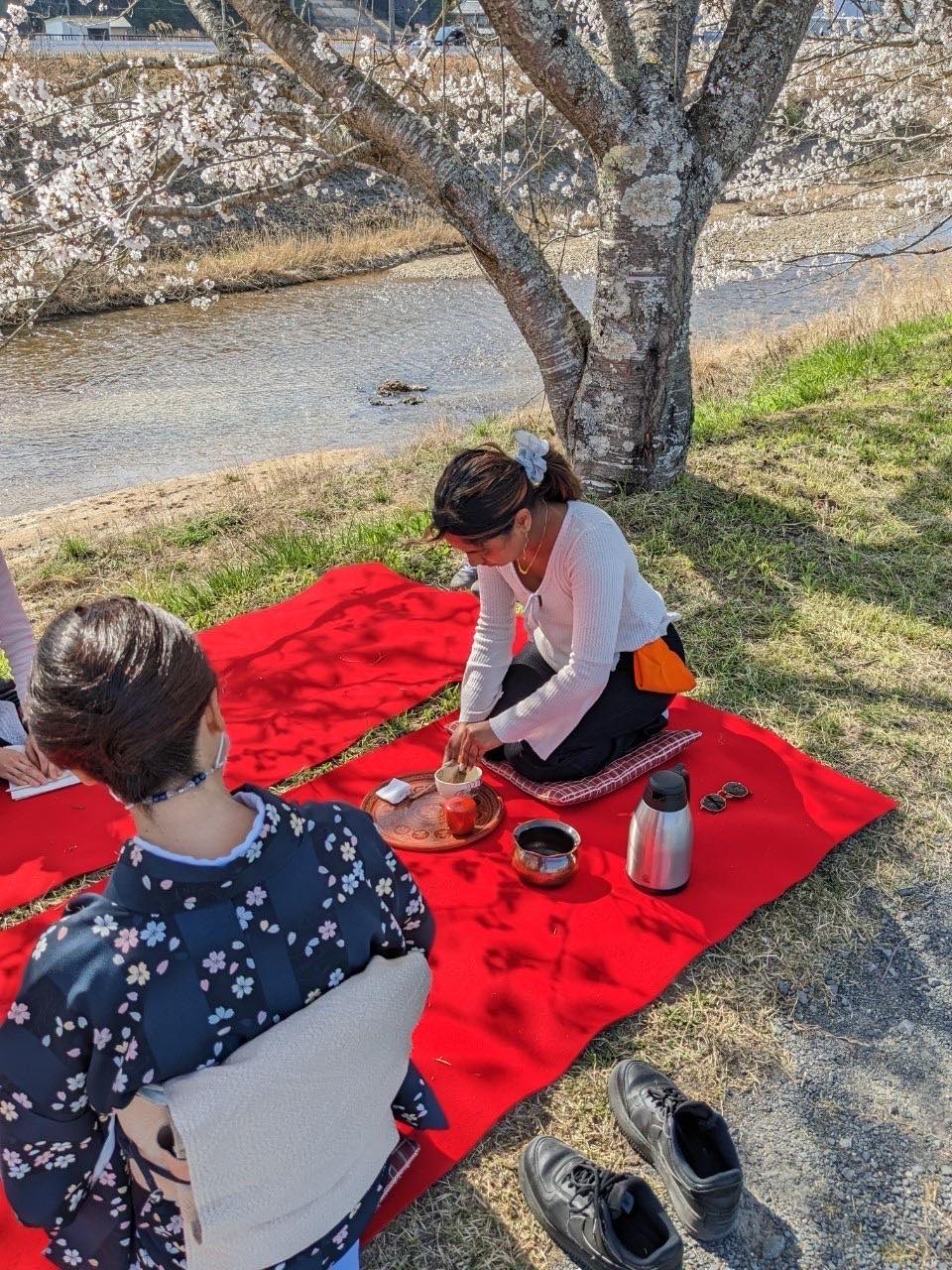
For my CIP activity, I took tea ceremony classes at Kyoto Wabichakai わび茶会(http://www.kyoto-wabichakai.info/). They took place once a week for around 2 hours. Even though this semester abroad was unfortunately cut short, I was able to take four lessons and learned a great deal in that time. I have always really liked Japanese tea and have seen videos about tea ceremony, but I still didn’t really know much about it. With the help of Yamaoka sensei, I found Wabichakai.

For my very first lesson, I mostly observed my sensei as she performed the tea ceremony for me, which involved multiple rituals, preparing and serving the tea, and serving wagashi, or a traditional Japanese sweet. The wagashi was one of my favorite parts of my tea ceremony experience, as the sweets were not only delicious, but they usually held some meaning. For example, one of the lesson’s wagashi was a plum blossom shaped mochi treat, which signified the winter season. I was also fascinated by the ritualistic nature of the entire ceremony. Specifically, everything was done precisely and a specific number of times. During the ceremony, my sensei also explained to me the history of tea ceremony in Japan. Although the vocabulary used was difficult at first, it got easier as time went on through the use of flash cards.

Subsequent lessons saw me more active during the lesson. My sensei taught me how to properly hold a tea bowl and how to drink the tea. Everything had to be done precisely and cleanly, especially when eating and drinking. Moreover, another one of my favorite parts about my experience was the field trip we made to Kitano Tenmangu shrine. The time we went, they had a plum blossom tree field for plum blossom viewing. Not only were the plum blossom trees beautiful, we also got some plum tea. My sensei also explained the history of the temple to me, as she is also well-versed in Kyoto history.

I really enjoyed the one on one nature of the lessons, as it allowed me to really build a relationship with my sensei. Not only did we perform the tea ceremony, but we also learned about each other as well. She told me about her experiences living in San Diego when she was younger and about her daughter. We also talked about my other classes, my family back home, and about my homestay family and experience. Even though I only had a few lessons with her, I feel like we were able to build a relationship that will hopefully last for years to come.

Despite the craziness of the past couple months, my CIP experience was a worthwhile one, and I plan on taking another lesson when I return to Japan in the future. I am grateful for the time I was able to take lessons with my sensei, and I look forward to seeing her again the future.

Peter Gilbert: Futsal Circle

Throughout the spring semester I participated in a futsal circle called “Ivy” as my CIP. Futsal, if you don’t know, is basically indoor soccer on smaller fields. We had practices on alternating Tuesdays and Sundays near Takeda station, and it was a very casual experience. During the spring semester most Doshisha circles don’t have activities until April, so with the help of my sensei I was able to find a circle outside of school. The circle mostly consisted of people who are already working, but there were some other university students as well. Even if there weren’t any university students I feel as though I still would have fit in well though. Everyone there was very kind and welcoming and I’d definitely recommend it to anyone looking for a soccer circle to join. The practices mostly consisted of scrimmages and just having fun, and they also split it up based on whether or not you had previous soccer experience, so I think anyone could fit in well.

At first I was quite nervous attending the practice, as I really had no idea what kind of experience to expect. I was pleasantly surprised and everyone there was extremely kind. It was a bit nerve wracking through, since I was the only foreign participant. Everyone else was Japanese, but I was able to communicate adequately and had a great time. Attending these practices definitely made me feel more comfortable using my Japanese with new people. It was a bit scary at first, as I really didn’t want to offend anyone, but I don’t think anyone should worry about that too much. Everyone there was extremely welcoming, and even complimented my Japanese although I’m sure they were just being polite. As for cultural differences between American and Japanese soccer, they weren’t really there. It’s pretty much the same game, and I can’t speak for all Japanese soccer circles, but this one was very casual and fun. One thing I did notice though was everyone seemed to be more polite and quiet when playing.

If I had the chance to choose a CIP again, I think I would definitely still choose “Ivy”, I had a great experience and would definitely recommend it. Without this circle I don’t think I would have been able to experience and meet new people who weren’t similar ages to me or university students. I was able to gain an insight into what it is like to work in Japan through their explanations, and see what some working people do in Japan during their leisure time. I got to hear about things like overwork and the working drinking culture, which was pretty interesting to me.

As advice for people looking for their CIP, I’d definitely recommend starting your search pretty early. I was determined to do some kind of sports club/circle when I was looking, and it turned out to be more difficult than I thought, especially because it was the spring semester, as I mentioned earlier. If anyone is struggling to find their CIP or currently looking, I’d definitely recommend contacting as many circles and groups as you can, as you never know if you will receive a timely reply. For my future kohai I hope you all enjoy your CIP to the fullest, don’t be shy, and make as many friends as you can. I’m really glad I had the opportunity to join this circle, and if I have the opportunity, I would definitely do it again.

Lucy Shauman: Filmmaking Club

For my CIP activity I joined a film club at Kyoto University called “雪だるまプロ.” I have experience working on film sets, so I was hoping that I could use my technical knowledge to make some lasting friendships with Japanese people who share my interests.

Since I joined at the beginning of Kyoto University’s spring break, it took a little while for the club to start making any films; the members where engaged in final exams for the first few weeks I attended their meetings. However, I did finally get to work on one upperclassman’s film set and was offered the role of sound recorder right off the bat. The club’s weekly meetings were usually very short, and I found it difficult to talk to the few members who showed up. However, the set dynamic was much more relaxed, and I was able to interact with people more easily. I definitely felt like part of the team when I could contribute my skills and work with the other members to create a film.

Although I only got to participate in my CIP for about two months due to the unfortunate spread of the Coronavirus, I think I had a very valuable experience. I learned a lot about the differences in how a Japanese film set is run, and was able to develop a Japanese vocabulary pertaining to film terms and equipment; for example, lights (照明), shotgun mic (ガンマイク), and storyboard (絵コンテ) were all words members often used. To my surprise, the club did not begin a take with the classic “lights, camera, action!” directive, but instead started filming after recording the sound file number and counting down following an exclamation of “演技おおい!” I also got to practice operating sound on set, which is something I did not have a lot of experience doing before I arrived in Japan.

While I would say that overall my CIP experience was positive, I had some trouble with this group at the beginning and considered switching activities. My first interaction with the club was very welcoming; I was shown the clubroom and two club members asked me out to dinner with them. However, by the second meeting I felt like that initial interest had altogether vanished, and I spent what short time of the weekly meetings I could trying to get other people to interact with me without coming off as creepy. I usually managed to hold a short conversation with one or two people each meeting, but it was stressful to be the only one asking questions. I decided to stick it out until the first film shoot, and my experience drastically improved once I was able to demonstrate my abilities by participating on set, but for a while I had a pretty isolating experience.

My advice to subsequent students would be to find a group with members who seem genuinely interested in you. If you are not able to make connections within the first few meetings, try a different activity. Your time at KCJS is not nearly as long as you think it is, and ultimately, I think it is more beneficial to find a group that facilitates your ability to practice your Japanese rather than an activity that is directly in line with your interests. In the end, I was disappointed that we were called back from our study abroad just when I was starting to build relationships with my peers in the club. If I had had more time, I think I would have had an even more rewarding experience.

Elise Shuba: Volunteering at Mitsuba Kindergarten

I chose to complete my CIP volunteering at a kindergarten nearby Doshisha campus. I would head over after lunch and play various games with the children. On the day I would go, I would arrive after the kindergarten’s planned activities and official classroom time had already ended, so at this time all of the children would be grouped together and allowed to play with whatever they wanted. Depending on the number of kids on that day, we would often move to a bigger room with more toys. This meant that the ages varied from 3 years old to 6, which can be a huge difference when the kids are that young, but they all played together very well.

When starting, I was worried that the kids would be shy or afraid to interact with me, but those fears were unfounded and I was happy that they became excited to see me as the visits went on. The kids assumed I knew Japanese, so they spoke fast and used some local slang to the point where I often had trouble understanding the older kids in the beginning. As time went on and I got used to the way children talk, it became easier for me to understand. One thing that was hard for me when I first started was distinguishing between a statement and a question, since they all used casual speech and I was not able to hear their intonation well. The kids taught me more than I expected to learn, and not only about casual Japanese (such as replacing ない with へん, or young kids referring to themselves by their names instead of using the word “I”), but also about the Japanese method of raising children. For example, the kindergarten staff stressed responsibility in the kids for things such as cleaning up their own lunch area, gathering their items when it was time to go, and also encouraging the kids to look out for each other and holding each other accountable for helping out. It is a different atmosphere from preschools I’ve been to before. That said, kids are kids and I had a fantastic time playing with them every week.

In addition to learning from the kids, I was able to experience a bit of a formal environment with the staff at the kindergarten, where I tried my best to use keigo with my superiors. It was fun to hear お疲れ様です at the end of my shifts and be able to say it back. For any future students, I recommend making sure that they enjoy their CIP and feel comfortable speaking and participating during it, because that active participation is what really makes it worth it. Initiating conversation with people I don’t know well is not something I typically do, but I found that people are generally enthused if you attempt to speak in Japanese, more so if you initiate first, so I encourage everyone to go out there and do their best. Unfortunately we were able to continue our CIPs for only about a month and a half, but it was something that I would regularly not have had the chance to partake in and am glad that I was able to take advantage of this opportunity.

Zachary Armine-Klein: Kendo

For my CIP I practiced Kendo four to six times a week at the Kyoto Butokuden (Martial Arts Center). Overall it was a fantastic experience. The practices themselves were always brilliant, even if I was not. The variety of lessons was so challenging because every night a different Hachidan Sensei (Highest rank attainable) would lead and each had their own styles of teaching and valued different skills. Nonetheless, each Hachidan Sensei maintained a heavy focus on keiko (sparring) at a level of rigor I found to be noticeably higher than in the U.S. I loved this intensity. Everyone at the practice was so focused on improving that the room almost always felt electrified. During matches each person’s desire to win was palpable. Although exciting, this energy was also rather intimidating. The “regulars”  had rivalries with other people around their level and had specific Sensei with whom they enjoyed practicing. Also, the established Kendo students more or less knew exactly who they were going to practice with and where to go within the Dojo (practice hall), before practice had even begun. As a new foreigner who knew nothing of the Butokuden etiquette I spent my first week being nicely turned down when I asked to spar someone, and also getting yelled at by sensei for being in the wrong space during basics and drills. Overall, I would describe myself as being rather flustered and confused and in culture shock. 

But disorientation slowly dissipated. I began to know which drills were done on which days, which Sensei’s were more open to practicing with newbies and became closer with some of the other foreigners in the community. Near the end of the first month some of the other young adult “regulars” began challenging me during free sparing and I slowly became friends with a couple of them. It was during this time that one of the more notable Nanadan Sensei (second highest rank attainable), Imada Sensei, started hovering around my sparring matches. Finally, after a couple of days of hovering around and silently judging me, he approached and asked (ordered) me to practice with him. Imada Sensei’s sparring session was brutal. He ran me ragged hitting the same basics over and over and every couple minutes asking if I wanted to give up? Every time I would tell him no and push further than I thought possible getting past my earlier urge to give up. He kept me going for a full hour until the final drum sounded signaling the end to the practice. He would  simply tell me it was a good practice, let’s spar again tomorrow. It continued like this for about a week where everyday he would run me ragged and just ask me to see him again tomorrow. Finally, at the end of the week he approached me and invited me to come to his personal Dojo (Yubukan) on Sundays. Of course I said yes and after being accepted by one of the most respected Sensei the community opened up. Sensei’s that previously wouldn’t give me the time of day started practicing with me and actually giving me advice. The other foreigners, who I learned a lot of went to Yubukan, began telling me about other Dojos where they practiced and offered to introduce me to their Senseis, so that their Sensei might invite me to practice with them as well. 

By the end of the second month of rigorous practice, I received a fantastic opportunity when my friend Yusuke invited me and Tamara, another foreigner I had become close with, to come practice at the Kyoto Police Headquarters with Ito Sensei, one of the few Kyudan Sensei still alive. This level of expertise is no longer available to be earned and after the last of the Kyudan Sensei pass over this level of expertise will enter history. This practice was a blast, but absolutely brutal. Ito Sensei spent a good thirty minutes breaking down Tamara and my basic strikes and having us repeat them over and over commenting on a new error each time and making us do it again. He finally left us and told us to start sparring with the other sensei at the Dojo. I was certain we had disappointed him or failed in some way, but at the end of practice he approached us and asked if he would see us next week at his practice so we could work more on our basics. I was ecstatic and of course said yes. Ito Sensei’s practices became a highlight of my week every week, albeit an often exhausting and painful part of my week as well. Sadly, after only a month of this extraordinary access to a Kyudan Sensei we had to return to America; however, I did get to have one final practice and a send-off party with the friends I made at Kendo. 

For any future students at KCJS who want to practice Kendo I have a few pieces of advice. First of all, whether you have practiced before or not, make sure you are really committed to this before you start. In order to be taken seriously and have doors open up for you in the community you really need to give 110%. I saw other foreigners only practice once or twice a week and even though they had been in Kyoto for months or even years longer than me, none of the sensei took them seriously or gave them their full attention. Secondly, if you already have experience, the best thing you can do is just start going to the Butokuden. It is a central space where all the different students at a variety of Dojo’s go in order to practice together. It  is a great place both to practice and meet different sensei and players. Finally, if you haven’t practiced Kendo and are starting fresh, it can be hard to find a way into the community. Most people in Japan start Kendo as children so there are few dojo’s that take young adults, let alone young foreigners, on as complete beginners. When I asked around for a friend who was interested in starting to learn Kendo, most sensei recommended my friend join the Doshisha Kendo Circle-which is Not the Kendo Club! The Doshisha Kendo Circle is welcoming to taking on beginners. Unfortunately, unless you are going to KCJS for the Fall semester or full year it could be harder to find a Dojo, since the Doshisha Circle is on break during the Spring semester until mid-March. If you are determined to learn Kendo I recommend you ask your host family or the KCJS office if they have any connections they can call on your behalf. In my opinion, it is worth persevering since once you have that connection and find a Dojo, the Kendo Community becomes a wonderful and welcoming place that will enhance your experience as an exchange student in Kyoto.

Malcom Summers: Shogi

For my CIP, I went to a local shogi club in Kyoto and played/learned shogi. I first visited the club and told them I was interested. Then, I came back the next week to start. Throughout my time there I learned some shogi strategies and played several times against the people in the club. Since few people spoke English, I mainly used Japanese. I also borrowed and read a book to aid with my practice.

One of the first things I noticed was a lack of keigo usage. Even the younger kids just used です/ます form when speaking to adults. Meanwhile, the adults mostly used casual form. I believe this was due to the nature of the club. Specifically, senpai and kōhai relations weren’t really about age so much as skill. Thus, some of the younger kids didn’t use honorific forms because they were actually better than the older players.

I learned a lot of shogi specific vocabulary from the club. I think it may have been harder due to the fact that shogi terms aren’t exactly used in everyday conversation. This required me to actually review some of these terms before I went to the club. However, it was an enjoyable experience because, in between games, we would review what went wrong and where I could improve. As someone who has played a lot of chess, that part of the process was very familiar.

The best advice I can give to others is to find a CIP that isn’t as skill oriented. Unless you already do the activity at home/school, learning something from scratch is a very difficult process. Especially, learning in a non-native language. For me, playing chess allowed me to pick up shogi concepts quicker, but my CIP eventually became a chore. I had to spend time practicing in order to eventually win, but, when I became busy, practice was difficult. So, when I would go back to the club it would be the same result of me losing the entire time. As such, I think a more social oriented CIP could lead to a better experience.

Kyle Matthews: DJ Circle

This semester I continued attending the Ristumeikan DJ circle “Label”. Every Tuesday we met for practice at a local bar in Kyoto-kawaramachi. Practice is usually structured so that everyone is able to DJ for about 20 minutes or so. We had some new members join this semester, and since I had been around for a while I was actually asked to teach them the basics by some of my senior members. Other than just practicing DJing we also had plenty of time to chat about music or school. This semester one of the things I noticed was more of the relationship between new members, senior members, the president, and the owner of the bar we practiced at. I was really surprised to see that attendance to the club was not strictly enforced at all. In my own school club back home if you miss 3 meetings you will he kicked out, however attendance in the circle here was not demanded of members. Because I attended often however, I was able to become close to some of the senior members of the circle. I found out as the semester went on that our circle was actually using the rehearsal space for free, and that there was a deal between the circle and the owner of the bar. Because of this, it was expected of you to order some food or a drink when coming to practice because we were able to use such nice equipment and space for free. We were very fortunate to be able to use that space.

As far as advice goes for choosing your own CIP I think it’s important to choose something you have an interest in. Not only will you be motivated to attend your CIP more often, but you will learn more Japanese words related to your hobbies or interests as well, which will make talking to your friends and expressing yourself much easier.

Mina Horner: Sumi-e Lessons

For my CIP I chose to take sumi-e lessons at アトリエ喜心. I knew from the start that I wanted my CIP to be art related, and I wanted to learn about something I wouldn’t get the chance to in America. I also wanted to do something I’ve never done before, and since I’ve mostly done pencil or digital art, working with ink was a completely new experience for me. 

Every week, I had two-hour lessons held at my teacher’s atelier. There were usually two or three other students as well, but they would filter in and out at their own pace. It seemed like many of the students had been going there for a long time and seemed to mostly use it as a workspace and for the materials. For my first lesson, the teacher had me paint only straight lines for two hours, which might seem menial but was actually very helpful in getting familiar with the brush and ink. I’m used to having the ability to erase or undo my mistakes, so working with a permanent medium like ink forced me to be more careful with my strokes and made me learn how to work with the mistakes I’ve made. The lessons usually consisted of choosing a sumi-e painting I liked and recreating it while receiving advice from the teacher. He would usually do a demo for me at the start, and since he would actually paint what he was explaining, it was very easy to follow along. I was also able to pick up some sumi-e and art related words. It was rewarding to see my own progress and how much more natural my strokes had become compared to the awkward, jagged lines I had made during my first lesson. 

lass. There were actually a few times where I lost track of time and stayed past my lesson time. Since starting college, I haven’t had much time to do art, so it was nice that I had a scheduled time every week to paint. However, I unfortunately didn’t get many chances to speak Japanese during my lessons, since the atelier was almost always completely silent, and it was hard to start a conversation. I spoke a little with my teacher, but it was mostly just him giving guidance on what I was working on. I somewhat regret not choosing a CIP where I could talk more with other Japanese people, as a major reason why I wanted to study abroad was to improve my speaking ability. However, I’m sure a big part of the reason why I wasn’t able to talk a lot was my own shyness. 

Overall, I really enjoyed my experience with taking sumi-e lessons. It was something I’ve never done before, and something I would have had trouble doing outside of Japan. However, if I could do it over, I think I would have chosen a CIP that would have given me more opportunities to speak and integrated me more into Japanese society. 

Leo Chau: Volunteering (子ども食堂)

My CIP was volunteering at Saint Mary’s Church’s Children soup kitchen with my good friend Alex. We would head over to the Church every Monday to help out for about two hours. We were originally tasked to help out in the kitchen by cutting ingredients and washing dishes. By the second time we went, we were instead redirected to play with and run around with the children. The actual period for serving food was 7 pm – 8 pm, but we came at about 6 pm, when kids started coming to the church. Every week we would end up playing with the children for about an hour, then help set up tables and eat the delicious food together! 

Instead of volunteering to help serve food to children, it really felt like I was volunteering to keep the kids entertained, which was really fun to do. When the kids played with us, they would speak Japanese too quickly and often with a Kansai accent. I wouldn’t understand them about half the time. One particular time, I asked one child to repeat what they said and they said it even faster to play with me. Being able to interact and communicate with the children was one of the best parts of my CIP and it made it extremely fun and enjoyable. With the energetic kids running around and playing with each other and the pastor and parents yelling at the kids to stop, it really made me think that young kids really do act the same no matter where you go.One big thing that I noticed when observing the children was that they would actually clean up by themselves after eating and would move back the table they ate on by themselves. It surprised me because that rarely happens in America. I feel that most children in America probably wouldn’t clean up unless their parents yelled at them to do so. Another cool thing that I was able to observe is the different kinds of games that kids play in Japan and how some games are basically the same in America, but named differently. For example, “onigokko” is basically just “tag”. Another cool thing that I was able to observe is the different kinds of games that kids play in Japan and how some games are basically the same in America, but named differently. For example, “onigokko” is basically just “tag”. Another cool thing that I was able to observe is the different kinds of games that kids play in Japan and how some games are basically the same in America, but named differently. For example, “onigokko” is basically just “tag”. 

Not only was interacting with the children fun, but it was also fun to talk with the other volunteers and the parents. I was able to feel how nice and caring everyone was. Learning about the backgrounds of each person was also very interesting! I was also able to learn new vocabulary and random knowledge from them! 

I feel that it was such an honor to be able to have been part of the church’s community, filled with caring and generous people. I wish I was able to help out more and were able to connect more with the members of the community. I especially wanted to connect more with the pastor of the church. During my last meeting with him before coming back to America, he brought us out to eat dinner and we talked a lot about religious things. But while he was driving me back home, I found out that he was also a big anime fan and I want to talk more about anime with him! It is a shame that my CIP activity was cut short. When I visit Japan again someday I will for sure make a stop at the church and say hi!

Megan Everts: Klexon

Originally, for my CIP I wanted to learn more about Japanese calligraphy, so I attended an introductory session where I met the teacher and the children taking the class. Although everyone was very welcoming, I quickly realized that children speak very quickly and are hence difficult to understand in Japanese. I thought more about what I wanted to get out of my CIP, and I realized that although my interest in exploring calligraphy was strong, I did not think it was the right activity for me to pursue. My main purpose of coming to Japan was to improve my ability to speak Japanese and to gain a greater understanding of Japanese culture, and I felt that there were other options that would allow me to pursue that goal more deeply.

So, I ended up changing my CIP to a language exchange club called Klexon, where both foreigners and Japanese individuals met to have conversations in English and Japanese. Klexon meetings were divided into two parts: one-on-one discussions and group discussions. The former had a similar format to speed-dating, where I would spend ten minutes talking with one Japanese individual and then my partner would switch. For the latter, the groups were randomly created to have a mix between foreigners and Japanese individuals, so I often got to meet more new people outside of the ones I interacted with in the group discussions.

I was able to gain a lot of interesting insights into Japanese culture through my interactions with these individuals. For instance, one thing I found very interesting when talking to the Japanese individuals is that they constantly commented on how bad their English was, even though I did not have much trouble understanding them at all. I thought that this was odd at first, but then when I switched to speaking in Japanese with one girl, I prefaced it by saying that my Japanese was not very good. She found it very funny that I said that and commented that she feels like sometimes foreigners start to “act more Japanese” after they begin studying the language, as she said that the way I talked down my ability to speak Japanese parallels the same way many Japanese individuals may talk down their ability to speak English.

Similarly, I had a conversation with another Japanese person about the differences between American and Japanese cultures. One of the interesting points she mentioned was that she said she felt like Americans were very aggressive and blunt in interactions, making them sometimes difficult to communicate with. This made me more aware of how to handle myself in future interactions with Japanese individuals, as I tried to pay more attention to the way in which I said things in order to minimize any awkward vibes I may have been giving off.

There were, however, some difficulties with my CIP as well. For example, when we transitioned to group discussions, sometimes the native English-speakers would take control of the conversations, causing the Japanese speakers to become more shy and talk less. This was frustrating, as my main purpose of coming to this club was to speak with the Japanese individuals, rather than other foreigners. For future KCJS students, my advice would be to not be afraid to reach out more to the Japanese individuals you interact with during your CIP. I wish I was able to get the Line information of some of the people I talked with to continue conversations beyond that short period of time.