I wanted to join a light music circle not only to improve at guitar and learn to sing in Japanese, but in small part due to the influence of Kyoto Animation’s K-On. Along with a healthy dose of other slice-of-life anime, joining seemed like the perfect way to inject myself into Japanese university life. At Doshisha, we KCJS kids really stick together. Fusokan and the cafeteria are our own little islands, and it’s difficult to break out of this bubble to interact with Japanese students. I was introduced to the circle thanks to the help of a Kyoto University student that I met during orientation, and after a few emails and twiddling my thumbs for the circle to get back from summer vacation, I dropped myself into the fast-speaking, slang-slinging world of Japanese college students.
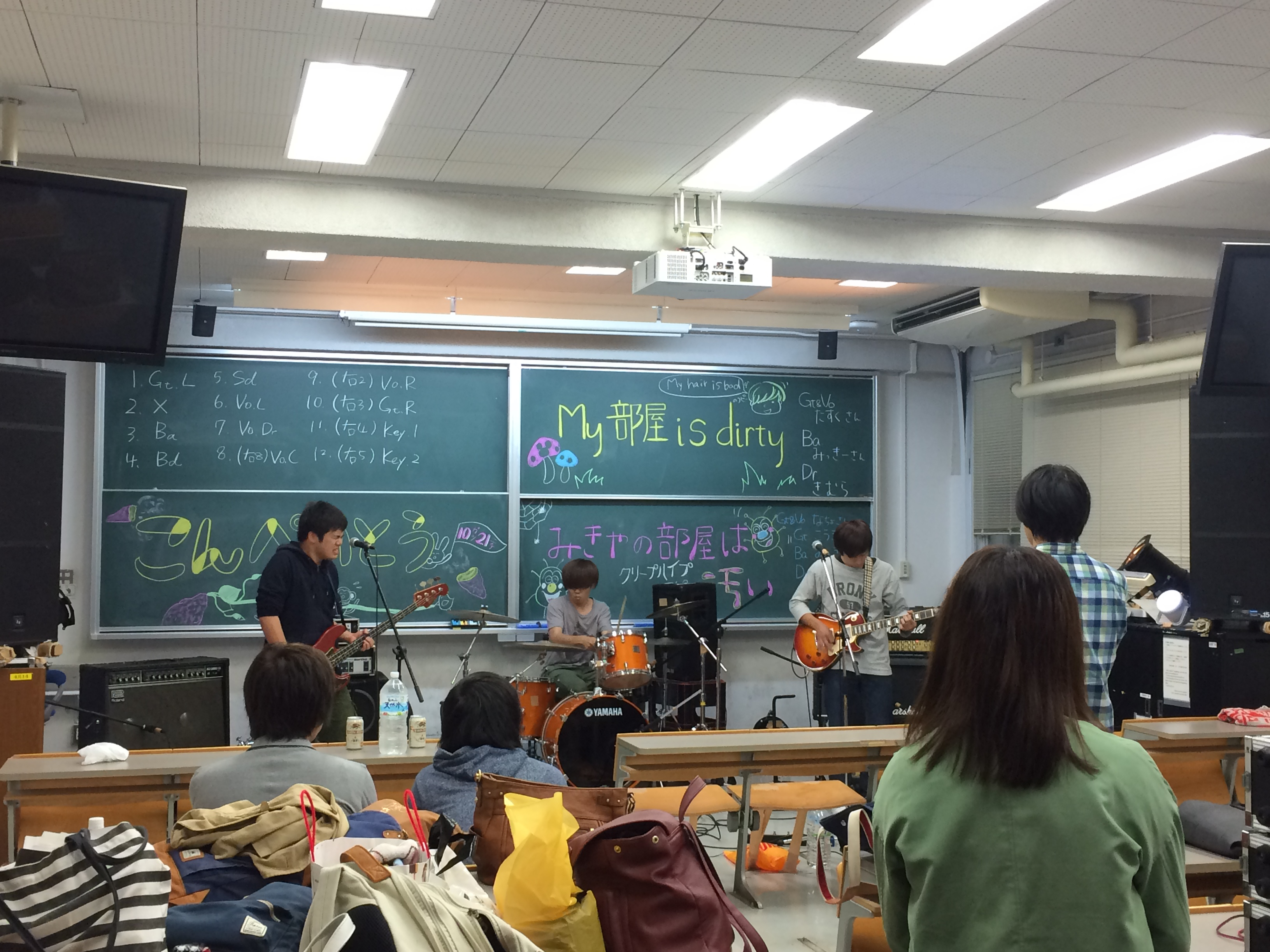
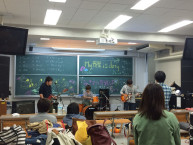
コンペイトウ meets once a week every Wednesday in Yoshida Building 4 at 7:30pm, though they’re not meetings in the traditional sense. Rather, they’re live shows, showcasing two cover bands made up of members of the circle. Half of the fun are their ridiculous names like Bump of Chicken, My Room is Dirty, and Nicke L. Back (a metal band). The genres range from anime songs to thrash to punk rock. An impromptu stage area is created by unbolting desks and chairs at the front of the room, and the group shares a handful of amplifiers, monitors, and a well-worn orange Yamaha drum kit. Once the lights dim, the opening band begins, tearing through a full setlist of covers with a gusto and talent that’s hard to match. After a quick break to change equipment, the headliners come on, skillfully shredding their way through another set, and then one more as an encore. The first time I went, I thought that the final act played so well that the crowd couldn’t help but ask for one more song, but after subsequent visits, I realized that the circle always asks for an encore no matter how the band did.
That first night, I went with one of our CIP mantras in mind: sometimes it’s good to be just an observer, and other times it’s best for you to jump straight in. I kept weighing those options as the evening went on, finally getting my chance during equipment cleanup at the end of the concert. Even the club members who are a part of the circle just to listen help pitch in to move equipment and put the classroom back together. It was at this time that I jumped in without being asked, and before long, inquisitive club members noticed me and began striking up conversation. I’ve met new people every week, but one thing that happened every time, without fail, was how cool people thought it was that I was from Las Vegas. They seemed quick to accept me too, even with my meager A-Class-level Japanese. At times, they could pick up that my fluency was still quite slow and adapt, while others they would speak at fluent speeds and I strained to keep up, afraid of asking them to slow down. I think that knowing a handful of Japanese rock bands helped me a lot, as everyone seemed surprised that I knew some of their favorite groups.
Dropping myself into those situations has certainly helped my Japanese and my perception of Japanese culture, though. Where I before dreaded (and to be honest, still dread a little bit) having to use and decrypt keigo on the fly, it was only after my early email exchanges that I began to appreciate how respected you feel when your respondent replies back in keigo. Listening to a variety of native speakers has helped me to be able to usually be able to pick out the main points of what they say, even if I don’t completely understand. The “every student pitches in to clean up” thing, which is regarded in foreign countries as the epitome of Japanese schooling and something that every nation should aspire to, is perceived as completely normal and not worthy of any special attention here in Japan. My host mother had a good laugh when I explained America’s strange fascination with that.
My time in コンペイトウ hasn’t been without its faults. Joining a band hinges on being a part of their mailing list, which even after giving email to supposedly the correct person, it wasn’t until three weeks later that someone realized that I hadn’t actually been added. Other than that, the circle doesn’t facilitate practices; it seems like once you get into a group, you do everything on your own before signing up to perform. At this point in the semester when the error got caught, with finals, papers, and winter break looming, it doesn’t seem like I’ll actually get to participate until next semester. Even then, with the semester ending in March, I’m not sure how much time I’ll actually get to have being an active member of the circle. For paying their membership fee and bringing my guitar from America with high hopes, several months of music appreciation isn’t exactly what I signed up for. I also feel like I would be getting more out of it, or at least better able to voice my concerns, if my Japanese were a lot better than it currently is.
I’m trying to keep my chin up. Getting put on the spot in conversation, without the aid of a conversation script or a dictionary, isn’t something that the formal teaching of a Japanese class can really prepare you for. You can only get better at with a lot of practice. At the start of the semester I was pretty concerned with speaking perfectly and figuring out the right words to use, but now I’ve loosened up and just speak as best I can, talking around what I’ve forgotten or what I don’t know, experimenting with new words and expressions that I’ve picked up from friends and from class.
Studying abroad here in Japan for a year makes me feel as if I’m living a double life. Truly, I’m shelving my life back in America for a few months, and injecting myself into something new and unfamiliar. Everything has a parallel — English for Japanese, my real family for my host family, Doshisha for Penn. But コンペイトウ doesn’t really have an American equivalent for me. I don’t have a group in America where I can let unwind for a few hours, talk excitedly about music, get insight into a foreign culture, and listen to two bands kill it once a week. I’m hoping that in time, hopefully soon, I’ll get to be up on stage in one of those too.