Katsumi Morales: Kyudo

There are several reasons that I am sad to see this Spring semester come to an end, and leaving my CIP behind is among the top few. My experience at the 道場, practicing 弓道 hasn’t been the most social or life-changing, but I am extremely grateful for having been given the opportunity to be taught by a proper instructor and train amongst other Japanese 生徒.

Although there have been countless awkward moments for me, whether due to my own lack of communication skills or due to making a mistake and dropping an arrow, my overall experience has been quite pleasant and I normally leave practice feeling somewhat accomplished. My teachers and fellow students have been very kind to me, and as the months flew by, I felt more and more welcome amongst them.

During my first few weeks at the 道場 back in September, a few foreign travelers came and went, practicing only a few days or weeks before leaving again. I remember 先生 talking about how even 4 months was not enough time to truly learn about 弓道, and I can say that after nearly 8, I still feel I have a long way to go until I can be called even “decent”.

Looking back, I believe there has been a very large difference between how teachers and other students treated those who stayed only a short time, and how I have come to be treated after being around for a much longer time. That is not to say that they treated anyone badly at any point in time, but that after 6 or so months there, I definitely began to feel a change. Despite having few conversations with others, I could sense that they had grown used to seeing me around, grown used to expecting me there. The times I did have conversations with people, they were always very nice and asked me about myself, and about how long I would be staying.

If I compare myself with some of the other students who had attended while I was there, I believe that my being there for a much longer time than the others, spoke of how serious I was about learning and practicing 弓道, as opposed to being there just for an experience in Japan. I got the impression that those who were only there a handful of weeks were really only doing it as a “one time” thing. せっかく日本に居るから. I and Jasmine who practiced with me last semester hope to continue 弓道 after returning to the states, and if possible coming back to Japan to practice again with a teacher. I am not too hopeful about finding a place to practice in the States as of now, but I will definitely keep my eyes peeled. I knew before I began here that I preferred 弓道 to Western archery, especially competitive archery. I had tried it for a year and a half and realized that the more spiritual and wholesome experience of 弓道 fit me better. I have found myself to be quite right in that respect. I am not the kind of person that enjoys sport and competition, but to me at least, 弓道 is something more.

I believe that it was my genuine desire to learn 弓道 as what it is and not as a sport, not as I learned Western archery in the past, that eventually helped change the way others looked at me. Even 先生 changed her attitude towards me bit by bit. Now I feel much more like part of the group of people there every Monday and Thursday. Unfortunately that only makes it harder to leave and I’m sure these last weeks will fly much too quickly for my liking.

Deanna Nardy: Manga

I don’t want to write this blog, because it means that my time in Okamoto-sensei’s manga class is almost over. Out of all the events and opportunities provided by KCJS, nothing made me feel more valued as a member of the community than my Manga CIP. I have made real Japanese friends (not just hey-we-met-once-and-added-each-other-on-Facebook-but-actually-what’s-your-name-again “friends”), people I will keep in contact with and, when I come back to Japan, will go out of my way to meet again. Manga class has been the one piece of home in a time abroad.

The incredible thing about my manga class is that everyone is completely supportive of one another. Whenever I felt dejected and thought “I will never be as good as A-san so what’s the point,” everyone was quick to tell me that my art is my own style and no one can draw the way I do, because the pictures I draw are mine, are special. It sounds cliché now, but that encouragement has meant the world to me.

This may just be the artist talking, but sometimes I look at what I’ve drawn, and I think, “Wow, I haven’t improved at all.” It’s easy to think this when Okamoto-sensei always couches praise between criticism: 「この辺はいいけど、この辺はちょっと…」. However, recently, a girl who had previously attended the manga class but is now a published artist has been visiting. Whenever she is there, Okamoto-sensei talks about me as if I’m not there and praises my work minus the disclaimers. “This is her first time inking, and you can see she understands when to make thin lines and thick lines,” “You should have read her Cheesecake manga, the action scenes were well done,” “She’s very patient and doesn’t rush, that’s why her art is clean” – after hearing all of this (for the first time!), I couldn’t stop smiling the entire class.

Now I realize that Japanese people in general feel more comfortable showing praise indirectly. Because I was only ever told points I could improve on, I interpreted that as I wasn’t doing anything right. However, that’s not the case at all – the second another non-student was there to listen, Okamaoto-sensei said only good things about my work. Perhaps directly praising someone runs the risk of discouraging the other students, or maybe you don’t want the student to get too cocky, but either way this dynamic is different from what I experienced in American classrooms.

I will never forget Okamoto-sensei, the kind assistant Fujita-san, the always-drawing-male-love-scenes-that-make-the-sensei-shake-his-head student, the two high school girls that are always squealing 「すげー!!」about something probably Sonic related, and the boy who offered me his heat pack that he fished out of his back when I said my hands were cold when we went out to eat ramen after class. Until we meet again!

Romana Perez: Niconico Tomato

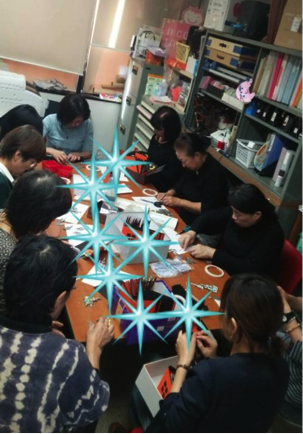
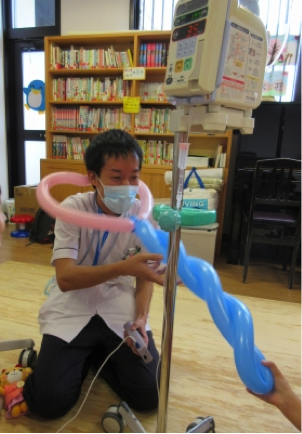
           For the past 8 months I have been volunteering at Niconico Tomato, a volunteer group at Kyoto University Hospital. I have had the opportunity to help kids staying long-term in the hospital. Most of what Nicotoma does is to create events for the children. At Nicotoma we often create intricate cards, do crafts with the kids, and have sales to raise money. I’ve particularly enjoyed created various crafts and using my hands to create something beautiful that a kid can enjoy. I am really glad to help the children have fun and I want to continue to do similar things in the future.

            Since I am leaving soon and returning back to America, I often think about how I can continue to help children in America with a similar program. I know there are programs at hospitals in the US, but they are often very different. The ability to play with the kids as a volunteer is the same, but often fun activities and events are lacking. I also find the attention to detail to be lacking as well. At Nicotoma, all seasonal decorations are taken care of very carefully and used year after year, where in the US new ones are often bought or old ones are easily damaged. Also, at Nicotoma every craft is organized and planed out in advanced, which allows the cards we make to be intricate, but very easily put together. I don’t imagine American programs to be as detailed and they would probably be bought. From what I’ve seen and heard from friends in the US who have volunteered in similar programs, the kids usually make crafts but rarely receive them from staff. Also, the regulations and rules for American programs are very strict and can restrict the fun the children can have. For example, a lot of the events we have at Nicotoma give the kids a lot of sweets. In America, since childhood obesity is a big problem, I don’t think we could do similar activities.  

Either way, if I do become a doctor I want to continue to help however I can. I also want to maybe take what I’ve learned from Nicotoma to improve any program I’ll participate in the future. One idea I have if I am able, is to maybe set up a pen-pal system between American children and Japanese children. I think it would be a very cool activity for kids to talk to each other around the world, especially ones with similar situations. So hopefully I can accomplish that goal.

            One thing that remains the same between the two countries is the energy of the kids, and I want to protect their hopeful outlook on life. I’m a little sad to leave Nicotoma, but I know they will continue to give excellent care toward the kids. I’m glad to have been able to make a difference, however small. I’m glad to have picked this as my CIP. I am also grateful to the kindness of the members of Nicotoma who were always helpful and generous. I had a lot of fun (and snacks!) and I am just very grateful for the experience.

Aubrey Harper: Pottery class and Klexon

I started off this quarter doing the same project as last quarter, pottery lessons.  I started the lessons late so they carried over to the first half of this quarter.  I really enjoyed the lessons, but when it was over I wanted to find a CIP that didn’t cost as much money. One that cost no money would be even better.  So that narrowed my options down to clubs and volunteering, unfortunately the circles at Doshisha weren’t very active this semester because the Japanese students were on spring break for two months in February and March.  I began to look into volunteering opportunities, but I was wary of committing myself to something when I was going to be gone in a month and a half.  I was rereading the other student’s entries to try and find something and I stumbled upon Klexon.

Klexon is an international language exchange organization.  They have a meeting each week; they also have special events on weekends occasionally. I have only gone to a few meetings, but it isn’t as awkward as I thought that it was going to be at first.  I am a rather shy person; I’m not big on talking to strangers in English, let alone in Japanese.  But I found that many of the other people at Klexon, were just as nervous to talk to me, which somehow made it less daunting.  Many of the Japanese people at Klexon are students, but there are also a lot of office workers, who are transferring to an English speaking country or have spent time working in an English speaking country before. I also met a man who just quit his job and was planning on traveling the world.  Because Klexon is meant to be a language exchange program, talking to and making friends with the other people is expected and I found that while many people were shy like me, it wasn’t so hard after a few minutes to keep a conversation going.

With pottery lessons on the other hand, I felt like an outsider very keenly for most of the classes. I was not only a foreigner but also much younger than the other students and a first-time potter. Eventually I began to feel like I was gaining ground in the group, but soon after that the classes were over. I think that if it had been a longer class I would have been able to make more progress. I’m not sure that there is really a secret to making integration into the group easier, if there is I would like to know it. For me it just took time and being polite.

Cameron Bothner: Impact Hub Kyoto

Impact Hub Kyoto is an intense choice for CIP, make no mistake. The organisers,
since day one, have referred to us as interns, and it’s an accurate designation.
Impact Hub is no minimal-effort choice, but I’ve never been one to pick the
minimal-effort option.

If I had one fewer draw on my attention, then I would have been able to give as
much of my time as Impact Hub initially wanted. They asked for three hours of
work and one long hour of check-in meeting a week, plus regular attendance and
assistance at events. And I would have given it all, too; Hub is a cool
organization building the right kind of community and encouraging the right kind
of innovative-slash-disruptive ventures. As it turned out, after a near
thirty-hour weekly commitment to Japanese class, two arduous afternoon classes,
and an understandable desire to form meaningful personal relationships in this
new country, I only had two hours a week to spare. To see it written makes it
look like very little, but it was enough time each week to finish a draft of my
flyer template which I would receive comments on the following week.

More than just being an interesting project, however, Hub is a great place to
meet friendly, interesting people. The space, a cool retrofitted Noh Theatre,
encourages collaborative work and conversation, and there were always a few
members milling about. Impact Hub members are by their nature fascinating
people: artists, activists, academics, and entrepreneurs, and at events or
during the afternoon, conversation was always engaging.

However, either Hub is not really a characteristically Japanese organisation, or
Japanese organisations aren’t really that different from American ones. (I’m
inclined to think that it’s certainly not the second option.) Impact Hub
encourages individual creativity and emotional honesty, and a number of the
members’ English was better than all of our Japanese. This made Hub a
comfortable place to work, certainly, but I recognise that that aspect runs
contrary to the goals of the CIP.

Impact Hub Kyoto is not the CIP for everyone. In fact, it wasn’t the CIP for
everyone, and some found others after a few weeks. But I found it a valuable
experience.

Jameson Creager: Shamisen

One of the things I anticipated dreading most before coming to Japan was not having access to a guitar. I was thrilled when I learned that my host family in fact had one lying around that I could borrow. That is to say, I haven’t had to abstain from one of my most immediate needs, to make noise. I’ve also discovered another means of stress relief and enjoyment though my CIP, learning the shamisen.

With regard to the instrument and music itself, the experience has been demanding. As opposed to guitar, in which anyone can pick up a few chords and be on their way within thirty minutes of having touched the thing, shamisen requires diligence in order to achieve its potential. That is not to say the physical action of producing a tone is difficult, like learning a woodwind, but that one must be very conscious of their technique and take care to not play more than what is written. A good shamisen player is precise in their movements. There is also a barrier of entry for first timers: To play along with others, I had to learn how to read a new type of music notation that is counter-intuitive to the notation I am familiar with. Learning has made me much more grateful for how easy it is to make pretty sounds on my guitar at home. The real treat, however, has been playing with others at the studio.

For my first month or so, I visited Greenwich House, a small Japanese music studio, twice a week. I would go once for a group meeting of musicians and once for individual lessons. Recently, I have just been going to group meeting, although I have been spending just as much time there. Last week, I spent five and a half hours playing and lounging, which included dinner out with my teacher. The place has a really laid-back, friendly atmosphere, and in between pieces we snack on sweets and drink coffee that has been prepared in the jazz bar on the first floor.

The individual lessons have been incredibly helpful in the process of learning the fundamentals, but the group meetings are what I’ve come to treasure. A few times a week, shamisen, koto, and shakuhachi players gather at Greenwich House to play together. Depending on the day, the attendance varies. There have been times at which the tiny studio in which we meet has been uncomfortably crowded with players of all types and times in which my teacher and I are the only string players, helping a group of shakuhachi players keep rhythm. The smaller gatherings are preferable in terms of time the teacher can spend correcting our mistakes and teaching technique, but there is something magical about hearing it all together, as the individual parts play off each other and form a lush aural image. While traditional Japanese music is rather humble in light of the music we listen to nowadays, it has stark and devastating beauty when executed well.

I wish that I could continue going to the music studio after I leave Japan. My teacher and the other members of the studio have been incredibly welcoming. This CIP allowed me to integrate with a tiny, very specific group of people in Kyoto who share my interests. Just as I am becoming comfortable playing and conversing with the other players, my departure looms over me. I have thoroughly enjoyed involving myself with this group of people and learning from their experience and company.

Caitlin Conahan: Kyudo

When I first began searching for a study abroad program in Japan, I already knew that I would like to try kyudo. I did not really think that I already liked kyudo, I just have an intense interest in archery no matter its form. I was mostly interested in how kyudo and archery compared to each other. More so than any other type of archery, kyudo has a unique asymmetrical bow and accompanying form. I wondered how the equipment affected practice and how the people who practiced it viewed it. As a result, doing it as a CIP in which I had to go and speak with people in Japanese seemed perfect as it combined language and cultural learning with something I already had a interest in. Kawaguchi-sensei of the Budo Center seemed perfectly happy to take me on as a student, and I really appreciate her putting up with me and my terrible Japanese. Although the other teachers and older member of the dojo spoke with me from time to time and offered some advice, Kyudo is primarily about individual practice. While I am used to practicing archery completely alone, I was a little surprised by the fact that even as a beginner, the teacher does not really help after showing you the proper form. Unlike western archery, the focus on kyudo is on improving yourself rather than your aim and, rather ironically, proper form is actually more important than in western archery. In archery, if you hit the bulls-eye every time, your form is good regardless of how “proper” it is, but in kyudo, you improve yourself through proper form and as an added benefit your aim will also improve. Unfortunately, I had some trouble getting into actually practicing kyudo because everything from the equipment to the stance to the way the bow is held is completely, if subtly, different. I felt frustrated by the teacher’s lack of involvement with the students because I did not just have to learn kyudo, I had to unlearn archery. Perhaps if I was going to be in Japan for a full year or more, I would have gone to kyudo as often as possible and really got a feel for it. But I feel I bit off more than I could chew, trying to learn an art that takes a lifetime to master in one semester, two days a week. Despite those feelings though, I really enjoyed my time at the dojo. Although people who prefer competitive archery may not understand the spiritual element of kyudo, as someone who practices archery for the fun of it, I really felt a connection between western archery and kyudo. The form it takes may be different, but I feel people who truly enjoy archery whether it be western or kyudo, understand how important patience and diligence is in both archery and life. I hope people across the world can continue to forge connections when they are similar and learn from each other when they differ. I hope can give kyudo another try one day and can give it the time and care it deserves.

Hadley Hauser: Office Assistant

I was thrilled to try my hand at traditional Japanese pottery lessons as my CIP activity this spring, but the development of severe stress fractures in both of my feet limited my mobility for much of the quarter.  Still in the healing process, I have instead fulfilled my CIP duties by assisting Wada san and Shore san in the office.

I have been helping to update KCJS’s student handbook.  One of my tasks is editing its existing content for clarity and flow.  While doing so, I look for areas that could be improved by adding additional information.  I have been creating brief explanations for things that I wish I had known when I first arrived in Kyoto.  For example, how to watch for deals on Peach Airline flights, how to purchase concert or flight tickets at convenience stores, and how and why I should acquire an ICOCA card.  Looking back over the handbook has allowed me to reflect on all the ways in which I have managed to acclimate to my life in Japan, as well as on how different things will be after I go home to Chicago in a few short weeks.  Working in the office has also given me the opportunity to practice my keigo, which I seem to never use correctly.

Getting many first-hand encounters with Japan’s hospital system has been an eye-opening cultural experience in itself.  I have had to explain my pain to multiple doctors in Japanese, each time broadening my vocabulary with the words for new symptoms and medical procedures.  Never has the need for me to use clear, accurate Japanese been more important.  Though I did not expect to be spending two months of my Kyoto exchange on crutches, the situation has given me the opportunity to expand my knowledge of Japan to practical medical terms, and has given me confidence in navigating a foreign hospital system.  These eye-opening experiences will surely come in handy if I choose to live in Japan again later in my life.

マイルズ・ボスウェル:茶の湯ラウンド2

僕は今学期も同じCIPをしています。先学期私とHBさんは大変ゆっくりと抹茶の点て方を習ったので、自分たちの向上にがっかりしていました。しかし、今学期は全然違って、意外に上達しました。

しかし今学期が始まる時裏千家の先生とちょっと問題がありました。先生のアメリカ人に関する固定観念の通りに行動して、僕達は先生を怒らせてしまいました。その後、僕達の日本じんのようじゃない点巡って、先生が何時間も叱りました。先生の仰った「日本人になりましょう」という言葉を二度と忘れません。先生との雰囲気が落ち着いた後で、アメリカ人にとってその経験は大変気まずかった割りに珍しくて特に日本らしいこと経験したということに気が付いたんです。そういっても、二度とそんな経験はしたくないと思います。

つまり、今までお茶を習うのは簡単じゃなかったけど、がっかりした気持ちは全部なくなりました。

マルコム・マッキニー:同志社グリークラブ

一年前に,コーネル大学で、グリークラブに入った。アメリカの人気があるドラマの「glee」と混同しないように、グリークラブというのは、伝統がある男声合唱団だ。クラシック音楽に限らず,シーシャンティーや、大学の歌や,海外の音楽も演奏する。アメリカでは,絶対に忘れられない友達を作ったり,素晴らしい音楽演奏をしたりしたので、日本でも,同じ結果になるだろうかと思案し,同志社で、グリークラブを続けることにした。

僕が初めて行った練習は、とても面白かった。誰かがお知らせをするなり、皆が大きな声で、「した」と叫んだのを初めて聞いた時は,びっくりした。「した」というのは、「ありがとうございました」や「お疲れ様でした」が最後のモーラに,短くなったものだ。グリークラブの外の人に「した」を使っても,通じないらしい。滑稽だと言っても、日本の内輪のグループで使う独特な表現はアメリカのに比べて,全然違うと思う。

卒団生のためのフェアウェルコンサートが近づいてきたから、「蛍の光」と「You’ll Never Walk Alone」という簡単な曲しか完璧にはしなかった。すごく忙しかったから,何回も,同じ曲を練習した。それで精神的に疲れたのは言うまでのないが、グリークラブの部員の皆が日本人らしく、一生懸命歌っていたから、僕も精一杯頑張ってみせた。

You’ll Never Walk Alone」を練習しながら,日本人には,英語の発音が難しいということに気がついた。母音と子音の言い方に加えて、自然息の取り方と二重母音の区別のし方は、英語のネイティブスピーカーも、間違いがちで,全然易しいことではない。英語の歌にひきかえ、日本語のは,母音の言い方が同じなので、たくさん協同の努力をせずに、美しく,聞きやすくなると思う。

3時間経過した後に,練習が終わり,三回生が三山木という和食屋で晩ご飯を食べに行くのに誘ってくれた。しかし、食事をする前に,卒業生のための秘密の歌を練習しなければならないと言われた。驚いたことに,その秘密の歌は、コーネルのコンサルトでも、熱唱された「What Shall We Do with a Drunken Sailor」だ。本当に懐かしかった。その歌をよく知っていたから,発音や,音程や,テンポをアメリカでしたように提案できた。感動的なフェアウェルコンサートの後で,卒業生のために、三回生が歌ったら,上達したことが見せられるに違いなく、僕も嬉しくなった。

これまで,練習は一回だけだったが、友人を作るために、また参加したい。