Shuyi Shang: Ikebana

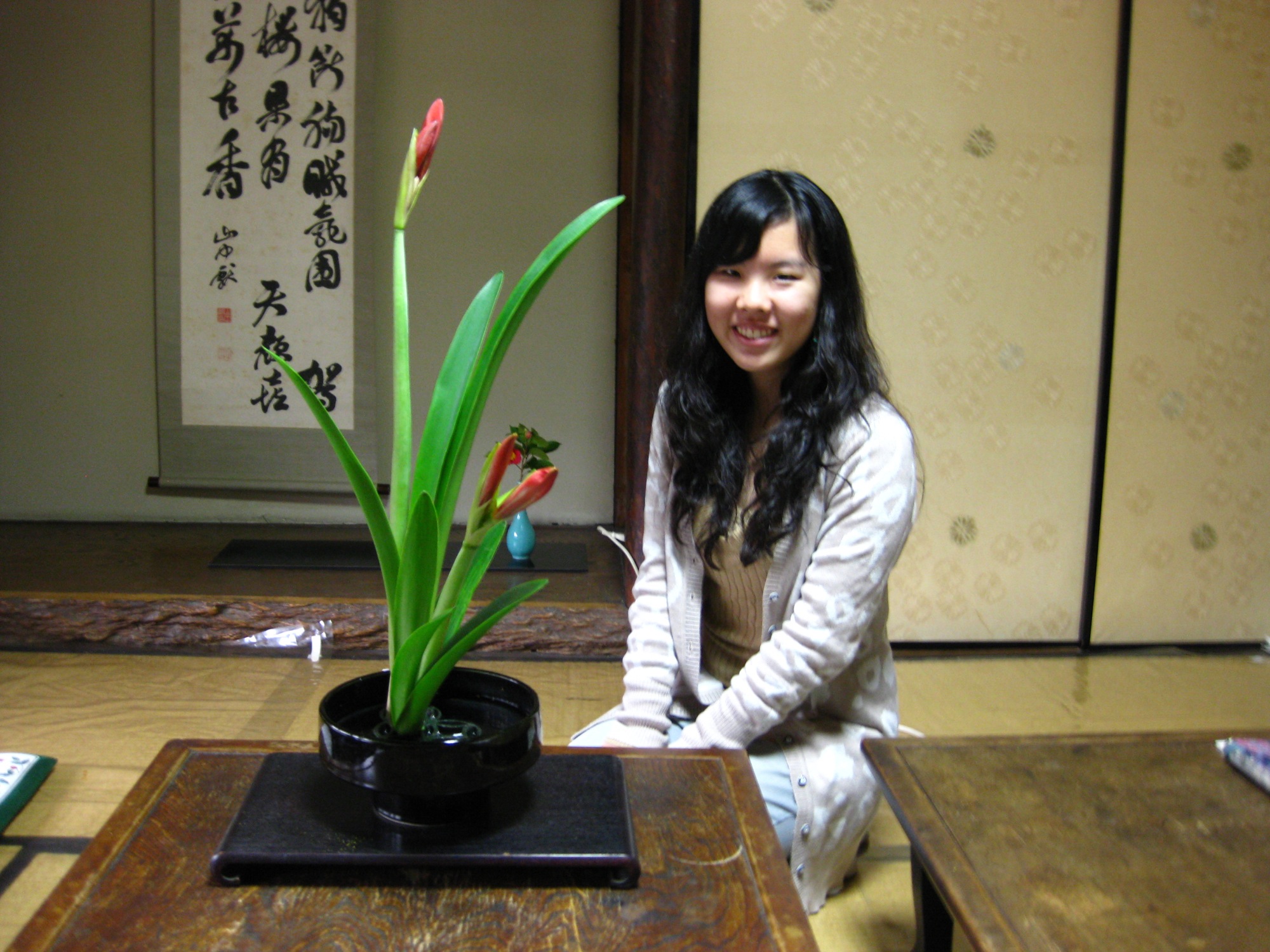
Before coming to Japan, my first and only encounter with ikebana was at a party held by my university’s Japanese department. It was not so much the product but the process, executed with such precision and elegance by my sensei, that moved me the most. Needless to say, when my KCJS sensei and I found out about several ikebana classrooms in Kyoto, I was ready to try my hands on creating ikebana of my own.

Now, after only six lessons, I am obviously still very far from understanding—not to mention achieving—that elegance. But along the way I have had a lot of fun learning about ikebana and interacting with my Japanese sensei and classmates.

Niwa-sensei, who just turned 79 last month, is a connoisseur of traditional Japanese arts. She enjoys showing and explaining to me about her collection of paintings, calligraphy scrolls, and other obviously expensive antiques. Our lessons take place at her Japanese-style house, and the displays of ikebana and crafts at the genkan and the tokonoma are frequently changed, making my lessons into a time for appreciation of Japanese arts. The first time I was there, she led me into a room and in front of a tokonoma, where she had placed a small vase of pine and a scroll of painting that complemented the ikebana. Pine is the plant of the winter, she explained. That was when I realized that acknowledging the current environment and time is very important in ikebana.

My four or five classmates (the number and people always change at each lesson because of different schedules) are all middle-aged Japanese women, which was not surprising to me at all. At every lesson, Niwa-sensei gives us each a sheet that explains the structural concept of the ikebana that we would do for today. The container is usually preselected by sensei, who has a collection of vases, plates and bowls for ikebana. We then unwrap our bundles of flowers and proceed to selecting, cutting and bending them in order to create the design we want. I receive frequent verbal instructions from Niwa-sensei, sometimes down to the specifics such as the angle at which I should place a particular branch. This is perhaps because I am only a beginner. Even though sensei and the students complimented on my works often, sometimes I wonder how lost I would be if I were to complete an ikebana work completely by myself.

Although we each sit at a separate table during class time and concentrate on finishing our work, the atmosphere is quite laid-back and sometimes small conversations pop up here and there among the students. Most students already know each other very well, so I have tried hard to understand and join the talks. I usually speak up when there is something I wanted to say or ask, and have always been warmly included in the conversation. One thing I like about the atmosphere in the class is that while the students are polite to Niwa-sensei, the politeness is that of a relaxed and natural manner, never stiff nor forced, making it easier for me to feel at ease even during my first lesson.

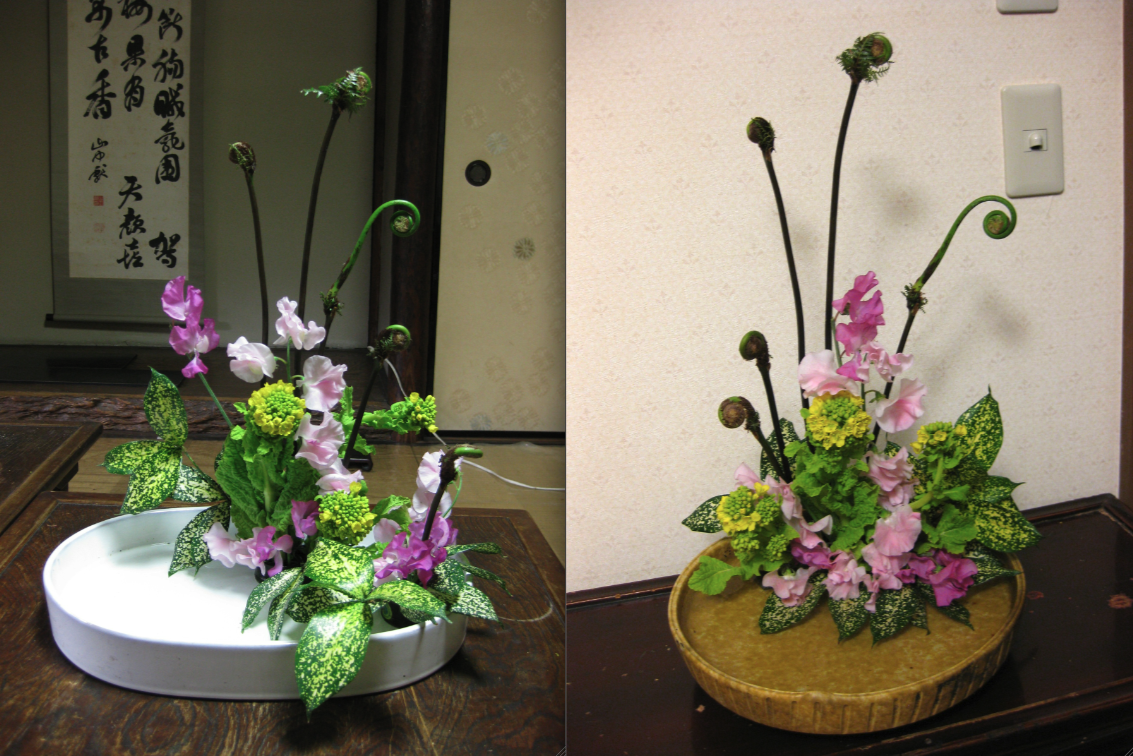
Although all students receive the same flowers and sheet, our works always end up looking very different by the end of the lesson. In my observation, there aren’t many strict “rules” in ikebana—at least not in the Sagagoryuu school in which Niwa-sensei specializes in. It is always a joy to see the various styles the same set of flowers could be arranged into, and the structural integrity they possess.

We can bring home the flowers we used in class for a second round of ikebana. As you can see, because what I have at home is different and most of the time limited, the ikebana almost always turns out differently. It's frustrating at times, but also part of the fun!


At the end of every lesson, Niwa-sensei always takes out her tea set and serves the students apple tea and delicious snacks. This is a time when we relax and admire each other’s work (and comment on how delicious sensei’s snacks are, of course). Although as a foreign college student I have little in common with the people around me, by listening politely and making a few comments here and there, I am able to have very pleasant conversations with sensei and my classmates, especially since they’re very open people who also happen to be quite curious about my foreign experiences. Tea time is when I can truly see the less formal side of the sensei-apprentice relationship that they have built over time. Although I am still new to the class, I feel welcomed and appreciated by everyone.

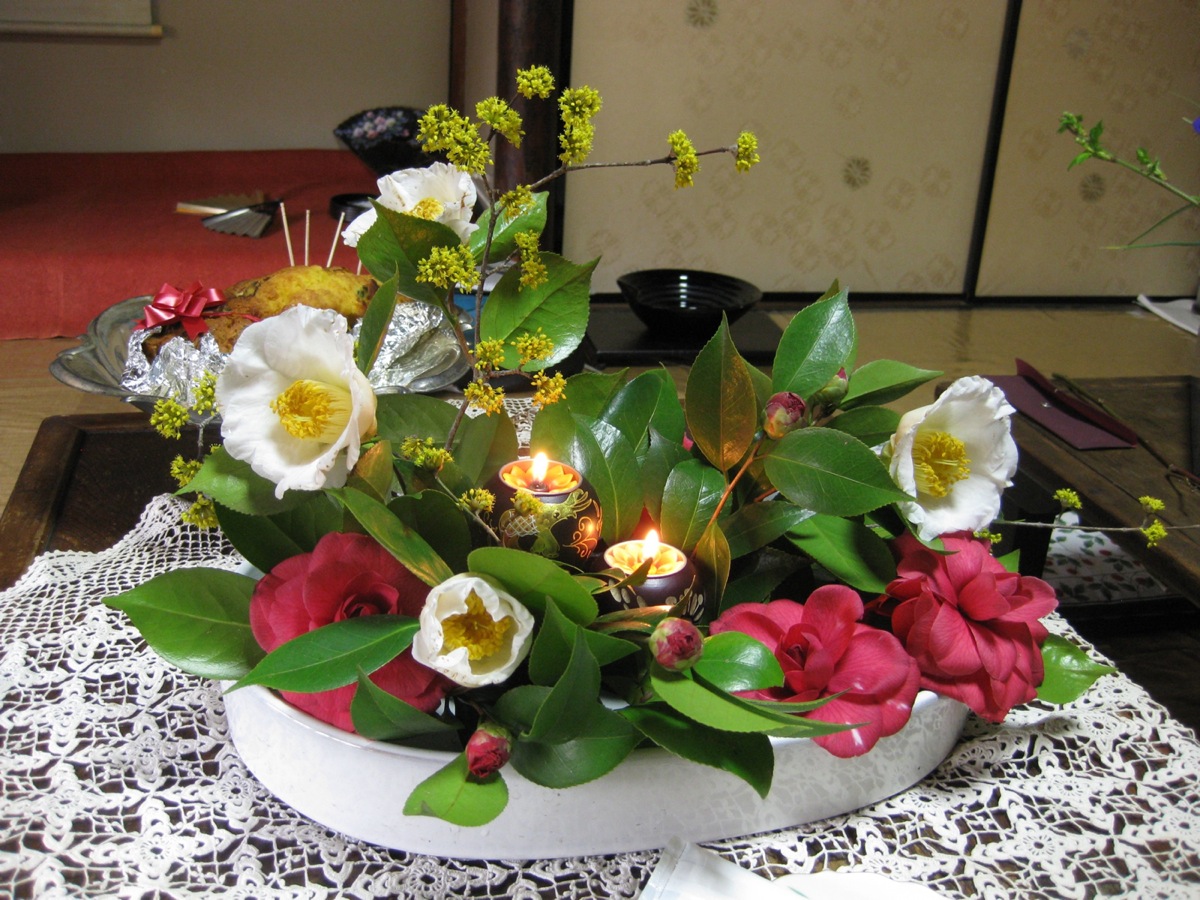
It was sensei's birthday, and she was so pleased with my birthday gift (a pair of Thai candles in carved wooden bowls) that she gave me a whole basket of tsubaki flowers and told me to design my own flower-candle arrangement. This is what I came up with. Not only did I complete two ikebana works in one lesson, we had a mini party enjoying homemade pumpkin cake, tea, and wakashi!

Unfortunately, my time in Kyoto is limited. It may take years of hard work to even begin to grasp the true essence of ikebana, and as of now I feel that I have hardly scraped the surface. What I can proudly say is that I have learned a lot about appreciating ikebana works in a more critical way, enjoying their beauty while recognizing the structural composition and possible concept behind each piece of work. In addition, this was a unique experience in which I joined a group of Japanese people much older than me, and learned about a beautiful Japanese art in a traditional house situated in a historical Japanese city.

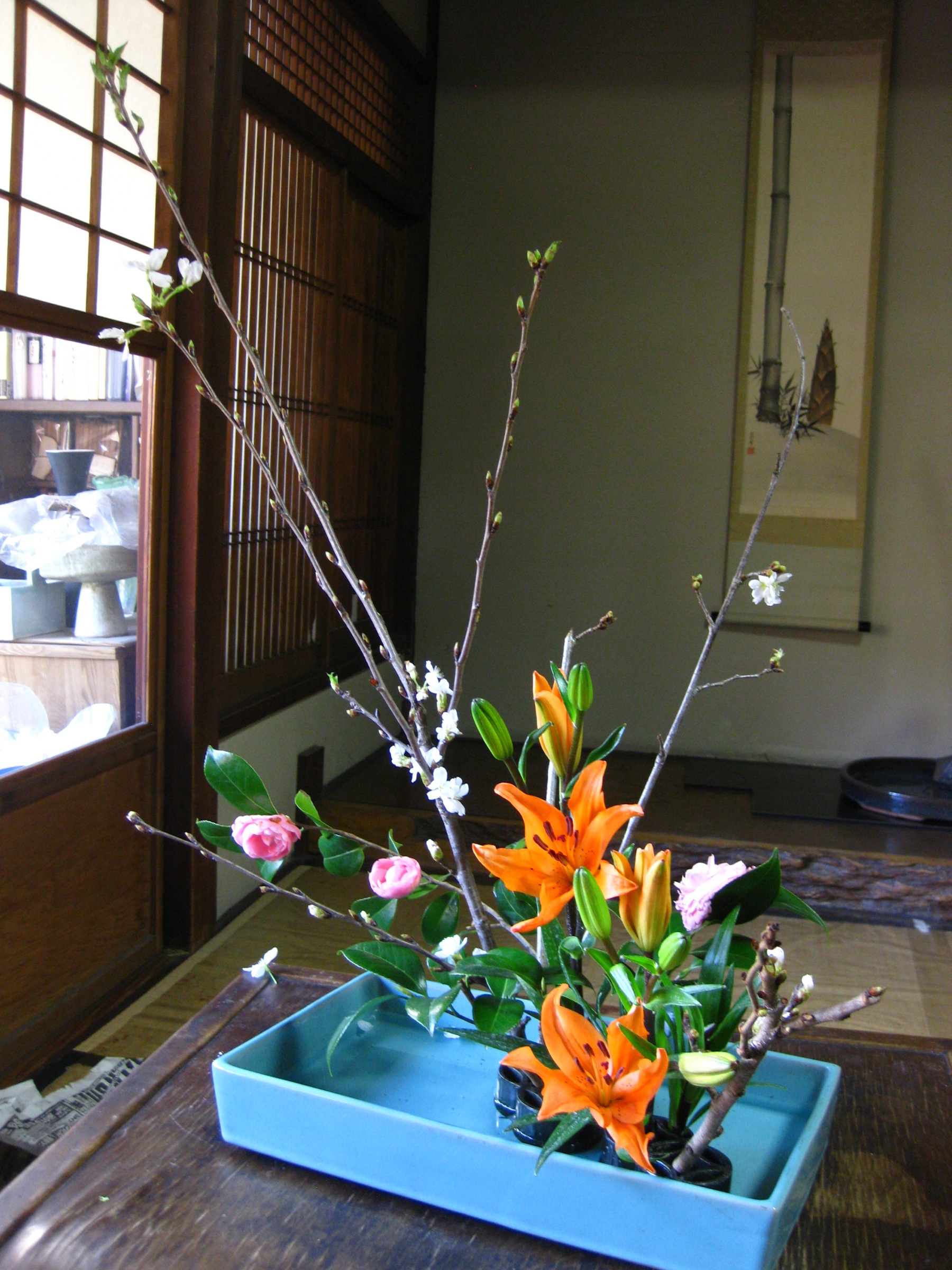
Completed in my most recent lesson (not sure how much I really improved but I'm really happy with this one). I like the rectangular plate, which complements the structure of this piece very well. And the large branches are sakura!


フィリップ・クアリング:北野天満宮の太鼓

 私のCIPは北野天満宮の太鼓のグループです。実は前期にそのグループで太鼓を始めましたが、CIPとしてはしていませんでした。子供から大人まで、様々な人が参加して、本当に楽しいです。 太鼓の種類と打ち方の技術が多くて、歌の中で違うメロディーがあります。
週末に練習があってたいてい3時間ぐらい練習します。その後で皆と一緒にレストランに食べに行きます。 年末年始とほかの年中行事を祝うために皆さんと本殿に入っていただきました。そんな経験は外人として特別なのだと理解しているから本当にありがたいです。ところで、3月25日に北野天満宮で18時から太鼓の演奏会を演してもし暇になったら行って見てください!

モリー・ライスマン:ニコニコ・トマト

私はCIP野ために京大の子供の病院のニコニコ・トマトというプログラムでボランティアをしている。ニコニコ・トマトは、重い病気がある子供のために楽しい活動を計画したり、小さくて、かわいいプレゼントを作ったりするプログラムだ。その子供の中で、一番小さい子は三、四ヶ月で、一番下の子は十八才だ。がんの子供が多くて、とてもじゃなしい。ニコニコ・トマトが計画したイベントにはまだ出ていないから、まだ子供といしょに遊んでいないが、小児病棟はもう見た。そうして、ニコニコ・トマトのコーディネーターにも外のボランティアにも会った。皆さんは中年の女の人だ。初回のボランティアの時、そのボランティアと日本語でしゃりべながら小さいプレセントを作った。そしてバレンタインデーの前に、きれいなバッグを作って、チョコレートとおかしをそのバッグの中に入れたり、きれいなタオルやハンカチでつつむ作業をしたりした。外のボランティアとしゃべるのはとても楽しかった。今後の活動で、子供と遊ぶのを楽しみにしている。

シューイ・シャン:生け花

今京都で日本語と日本文化を勉強していますが、大学の授業以外の経験も大切だから、CIPで日本人の生活を体験しています。私のCIPは二つの活動です。まず、「京都研究会」という同志社大学の散策サークルに参加しています。しかし、二月と三月はほとんど春休みだから、毎週活動をするのは無理です。それで、三月末までは、毎週楽しい生け花のクラスをとっています。生け花の流派がいくつもあるけれど、私の先生が華道「嵯峨御流」の先生です。日によって学生の人数は違いますが、私が今まで会った学生は四人で、みんな三〜四十歳ぐらいの女性です。外国人の大学生はもちろん私だけです。

一時間のクラスで先生のもとに一つの生け花をします。生け花はかなり深い芸術だから、毎回お花と容器が前のと違って、たくさん習っています。習う型を説明するシートも先生からもらいます。さらに、クラスで使ったお花を家に持って帰って、もう一度生け花ができます。私はもともとお花が好きなので、とても楽しくしています。

Phillip Cualing: Zainichi Korean Elderly Activity Center

The title is a mouthful, I know, but here are a few musings.

When I first walked into the center’s office, there was a major problem. Whenever I write, no matter the language, I tend to perfect my language so that I say what I want to say with the necessary eloquence. In English, it works out ok, because I can speak the language, but the problem I had was that the director of the activity center had a preconception that I was more skilled at Japanese than I actually was, which made it slightly awkward when talking about what I would be doing and what the center does. But we managed, somehow, to come to an agreement that I would come once a week on Wednesdays.

My first day, I was scared, to be honest. The staff had put the fear that I wouldn’t be able to understand anything into me, but it actually turned out well. We had talked about Zainichi Koreans in class a little bit, so I understood their background, but it was just nice to listen for a change. In class, it’s stressful for someone like me who is normally taciturn to always be speaking. I generally prefer to listen and to act than to speak, because I never was very good at gathering my thoughts in English even. And I really like going, because it’s nice to hear stories about their lives, especially since they would be much different than the average person in Japan. Sometimes they mix in Korean, and then I’m lost, but it’s a curious situation, because I’d really like to learn at least how to read hangul. I generally help out and clean after they leave for the day, and I’ve enjoyed the experience greatly. I’d like to continue going next semester, even if it isn’t for my CIP.

As a CIP, it’s not very exciting if you look at the logs. When you do the same things over and over, most people wouldn’t like it. But it’s fun to connect to a past generation with whom I share almost nothing besides the fact we breathe.  You learn things you wouldn’t otherwise, because the weight of experiences and memories shape each person differently. In some ways, I’m following down an analogous path; even though I was born in the US, I’ve never quite felt right at home, even if I speak the language well and interact in society. If I opened my mouth half the time to my peers to say what I wanted to say, rather than what should be said, I’d imagine people would be maybe a bit surprised, such are the differences I hold. But I’ve rambled for a bit, so I’ll finish with this: In such a place, home is where the heart is. Times change, places change, people change, so in such a world, those closest to you are the walls which support you.


フィリップ・クアリング:NPO京都コリアン生活センター

昔話など:京都のボランティアの経験

日本に来たときに、CIPで何をするかまだ分かりませんでした。アメリカでは,医者になりたいので化学などを勉強していましたが、KCJSではぜんぜん理系の授業がなかったから、病院でボランティアをするとかとか実験室で研究の助手がしたかったをはたらきたかったのですが、外国人にはどちらもちょっとむずかしかったです。

当初CIPとして太鼓をしようと思っていましたが、それをするのは毎週じゃなかったし、趣味だけでしたかったので、たいこにしなかったんです。私は「どうしようかなあ」と思いました。。。その時、文化の先生にコリアンセンターについて聞きました。去年はKCJSの学生が三人この場所に行ったとおっしゃいました。私はどんなセンターかわからなっかたけど,「楽しくて、いいところだ」と言っていただきました。メールをした後で、在日韓国人のお年寄りのためのセンターだとわかりました。

私は日本語の話し方より聞き方のほうがいいとおもうけど、お年寄りのにほんごはわかりにくいので、辛抱は大切なことだとおもいます。。でも、交流が好きです。日本に韓国からいらして違う経験があるからお年寄りの昔話はとても面白いと思います。毎週の水曜日、いった時はいつも楽しみにしています!