Jasmine Hensley: Kyudou

1417691_646093545447689_120065578_o(1)

Before applying for KCJS, I read up on the program parameters on the KCJS website.  Upon reading about the CIP assignment, I knew that I wanted to do kyudou because I had a previous interest in the martial art.  Initially I had been concerned that I would not be able to do it because I am very petite young woman and was without any form of archery experience.  Nevertheless, I pursued kyudou as my CIP, and began practicing every Monday and Thursday at the Kyoto Budou Center.

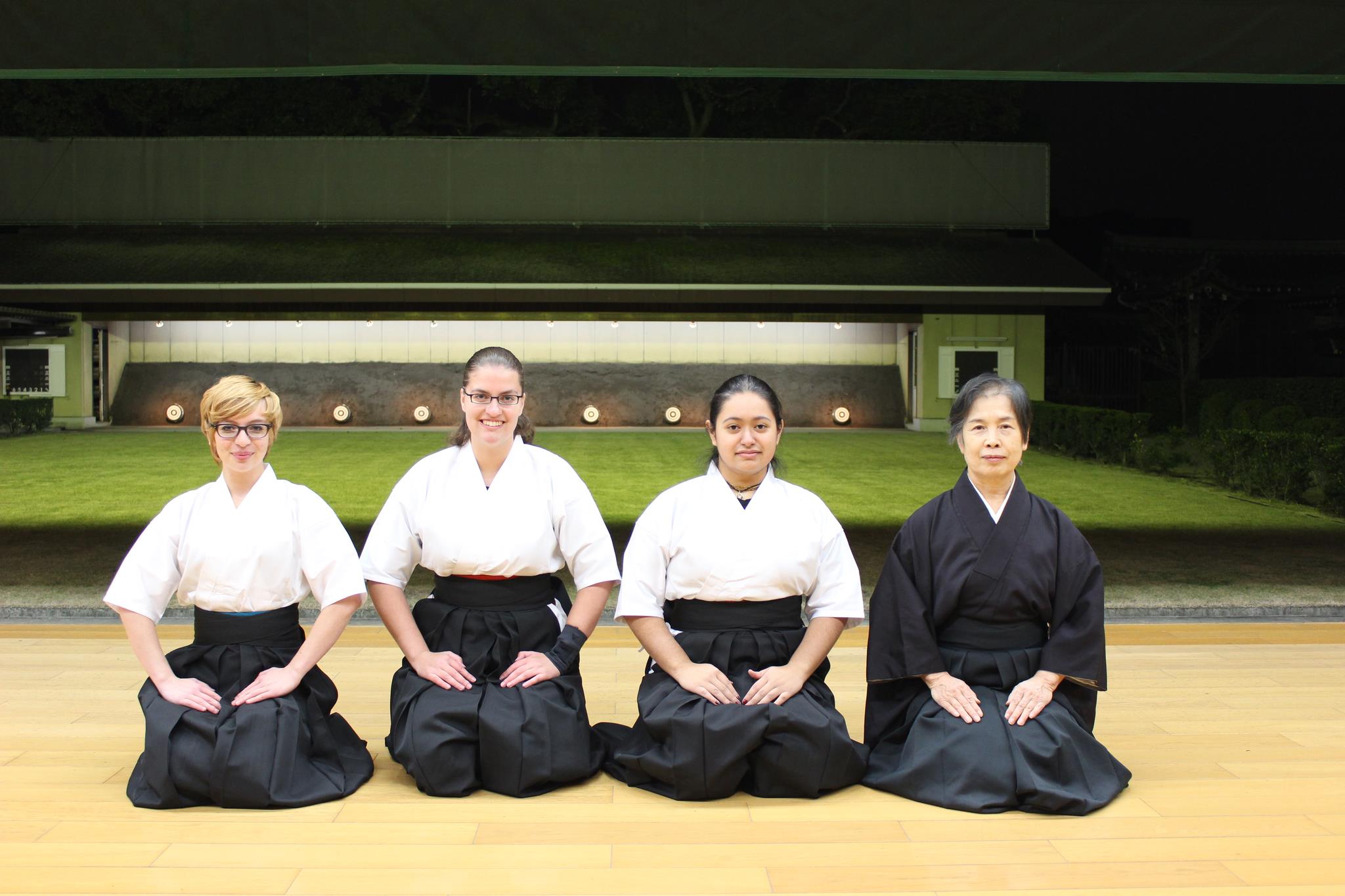
When I first entered the Budou Center’s kyudou dojo, I was pleasantly surprised to find that most of the archers were women around my size (though clearly much stronger than me from their years of practice).  Our teacher Kawaguchi-sensei herself is a sprightly and strong older woman with a commanding presence.  That is not to say that she was cold or unapproachable; on the contrary, she has been so kind and patient with us over the past few months, as have the other archers at the dojo.

Although practices are usually very independent, Kawaguchi-sensei and occasionally the other archers will offer tips and corrections to our postures.  Because kyudou is so ritualized, requiring one to repeat the same pattern of movements before every shot is fired, it is crucial to correct one’s movements before they become too deeply ingrained to be fixed.  I had very little upper body strength before starting kyudou here, so it took almost three months before I was strong enough and good enough to be allowed to move to a larger, heavier bow.  I don’t think that I could ever have imagined how much pride and self-accomplishment I would feel for being allowed to exercise harder.

Kyudou as a whole has served as a catharsis during my months in Japan.  This was my first time abroad, and the experience has been wonderful, but trying at times.  As I’ve become more aware of my linguistic inabilities, I’ve found myself losing self-confidence very rapidly; however, kyudou is an activity that almost entirely transcends the language barrier.  In addition, because there are other students who do not speak Japanese at all, I’ve gained some confidence in being able to translate between Kawaguchi-sensei and those students.  Furthermore, it is a time apart from homework where one focuses only on the ritual of drawing the bow and one’s own body.

Kyudou is definitely a CIP that requires time and effort, but the rewards far outweighed any measly inconveniences.  The support that I felt from Kawaguchi-sensei and the other archers, the atmosphere of the dojo, and the time for self-reflection not only helped rebuild and boost my self-confidence but also allowed me some peaceful time in my continuously active life in Japan.

Zalika Corbett: Weightlifting, Klexon (Language Exchange)

My CIP experience has a been a varied combination of people, venues, and activities.

After much searching, I finally came upon weightlifting. It was kind of a perfect fit, especially considering that I spent the first few weeks in Kyoto searching for some sort of sports-related CIP so that I could stay in shape. Weightlifting provided the perfect outlet to do this and, on top of that, the people there were incredible.

For instance, the first day I went, the main instructor asked me to perform a few basic excercises to check my form. This was not my first time weightlifting, but it was the first time that I had received instructions in such a detailed way. The instructor had video of professional female weightlifters doing the same exercise that I was and even drew diagrams on the board to explain exactly how to execue each lift. As a result, just a few hours into my first session, it became obvious that the main instructor and the student who taught with him were some of the the most knowledgeable trainers that I had ever met.

They were also some of the most patient. For instance, there was one excercise in particular in which I was disheartenly inconsistent. Sometimes I could execute the exercise reletively well, but on others it was as if I had never done the exercise before. Meanwhile, whoever was working with me gave me helpful, encouraging feedback.

Unfortunately, only a few weeks into weightlifting, I managed to injure myself in a way that prevented me from lifting for the rest of the sememster. As a result, I began to go to an international language exchange club, called Klexon. My first impression of the club was how organized it was. All of the English speakers were on one side of the tables, while the Japanese members were on the other. Then, every ten minutes, the Japanese members would rotate and start a conversation with another English speaker. The resulting process seem rather reminiscent of speed dating.

The second point I noticed was the variety of members. Initially, I thought that Klexon was mostly comprised of university students. However, I found that most of them were actually graduates with a wide variety of careers. During my time, there, I met doctors, salesmen, store owners, and that was just to start. In addition to the one-on-one session, we spent the last few minutes in small groups talking about set topics and then about whatever we so chose when there was a lull.

Overall, I think that both experiences, weightlifting and Klexon, were benefitial in their own way. I used Japanese more in the former, but there was not much in the way of conversation. Meanwhile, the latter was all about conversation, but the focus on English allowed for few opportunities to practice my Japanese until the final, group session. In the end, I am glad to have participated in both activities and, while I will miss weightliftng, I look forward to returning to Klexon to finish out the semester.
ヘンズリー・ジャズミン:弓道

子供のころ、日本の大衆文化に興味がありました。つまり、漫画とアニメが好きでしたが、他の日本の文化についてあまり知りませんでした。しかし、xxxHOLiC(ホリック)という好きな漫画が日本の民話と伝統的なことについての話だし、大学で日本の文化授業を取ったので、日本の伝統的な文化にも興味をもつようになりました。例えば、xxxHOLiCのキャラクターは射手だから、日本に来たとき弓道という伝統的なスポーツをやりたかったです。

九月から、京都大学の近くにある武道センターでかっこよくて強い川口先生が私ともう一人KCJSの留学生に弓道を教えてくださっています。弓道は難しいスポーツなので、初めは弓矢を使ってはいけませんでした。代わりに、上手な射手を見たり、射法八節という動きを練習したりしました。射法八節は「1.足踏(あしぶ)み」、「2.胴造(どうづく)り」、「3. 弓構(ゆがま)え」、「4.打起(うちおこ)し」、「5.引分(ひきわ)け」、「6.会(かい)」、「7.離(ばな)れ」、「8. 残心(ざんしん)」です。しかし、早く覚えたから、三回目には弓を使い始めて、四回目には矢を使い始めました。むずかしいですが、川口先生はいい先生だから毎回楽しいです。

弓道をやることが好きで、弓道場で日本の言語的な経験ができることも好きです。川口先生は強い人だから、時々「きみ」などの日本語を使います(以前に、アニメと漫画ではだけ見たことがありました)。そして、毎回新しい体の単語を習います。それから、川口先生は日本語がを知らないドイツ人の留学生も教えているので、私は翻訳の経験もできます。

だから、弓道に興味があれば、ぜひしてみてください。弓道に興味がなければ、勧めますよ!

コーベット・ザリッカ : 京大ウェートリフティング

 私はウェートリフティングのCIPをしています。どうやってこのCIPを見つけたかは面白い話です。スポツなど運動のCIPをしたかったのですが、ちょっと運が悪かったです。実際は女性の運動の活動は見つけにくかったです。色々なグループに連絡しようとしましたが 、一つしか返事をもらえませんでしたし。それで、ロスさんが私にウェトリフテングを勧めてくれました。高校の時、リフティングをして、とても役に立ったし、身体をひきしめたかったし、リフティングは素晴らしい選択だと思いました。当初、私は女性ですから、させてもらえないと思いましたが、それは問題ではありませんでした。

だから、一週間に二回ロスさんとリフティングをしています。そこにインストラクター二人います。一人は日本人で、一人は同志社大学の留学生のドイツ人です。その人はとても優しく、知識も豊富です。実は、今まで教えてもらった運動のインストラクターの中で、そのインストラクターが一番知識が豊富かもしれません。例えば、リフティングではフォームが一番大切なことです。だから、インストラクター達はみんなに個々のフォームがよくなるやり方を教えてくださいます。インストラクターの一人が私達が何かリフトをしてみると、どうやって直すか見せてくださって、しかも私達の母国語で説明してみてくださいます。とても思いやりのある方だと思います。

それで、ウェートリフティングをするのが楽しく、次回のレッスンを楽しみにしています。


モラレス・克己:弓道

私は、長い間弓道をしたいと思っていて、日本に来たら、弓道のレッスンを受けたり、弓道の部に入ったり、絶対するだろうと信じていました。実は、大学に入った時に洋弓を始めました。ウェルズリー大学の洋弓部はよく大会に出て、運動部らしいです。楽しかったけど、私は運動より、武道のようなものに興味があったから、運動部の競争心があんまり好きじゃなかったです。弓道は運動ではなくて、武道だから体も精神のためにやりたいです。もっと有意義だと思います。

KCJSに着いて、色々な面白いCIPの機会があったけど、やっぱり弓道をしたいと思っていました。他のクラスメートと一緒に先生に連絡して、レッスンを始めました。武道センターと言う所でレッスンを受けています。初めは見るだけでしたけど、二週目から弓で練習し始めました。今は、まだ本当の的を使わないで、似ている別の的を使っています。一週間に二回行って、一つのレッスンで何回も矢を射ます。時々、私の先輩が教えて下さいます。今まだ本当の的を使っていないけど、その前に、練習しなくてはいけませんから、大丈夫だと思います。すごく楽しくて、面白いです。やっぱり弓道を選んだことは間違いではありませんでした

Xinru Li: Aikido in Kyoto Budo Center

Choosing Aikido, a Japanese martial art, as my CIP is one of the smartest decisions I made this semester. I have been practiced Aikido for 2 years in Brandeis and now I have a different experience in Kyoto Budo Center. I feel so lucky to practice Aikido in a traditional Dojo with people who are really into it.

At first, I was worried about whether doing Aikido will help me to get involved into a Japanese circle or improve my Japanese. After talking to students who was in KCJS last semester, I realized that I wanted to do something interesting so I could enjoy myself and learn more. So, I started to do Aikido two or three times per week. When I went to the dojo for the first time, I was shocked that there were so many old people and I hardly understood their Japanese because of their strong accents. Luckily, Aikido does not need too much spoken language. Basically, one learns a technique by watching sensei’s demonstration and practicing with different partners. This means you have to adjust your techniques according to the partner’s stature or strength. There is not competition or match in Aikido. All you need to do is to learn from your partner. Even though I have trouble understanding their Japanese at first, most of them are so experienced that they can show me how to improve my techniques.

Compared Aikido Club in Brandeis and Aikido dojo in Budo Center, etiquette is more strict in the Budo Center. I don’t even remember how many times I say arigatogozaimasu(thank you very much) and onegaishimasu(please teach me) in each practice day. Also, thanks to Aikido here, I can sit in seiza for a longer time. To some extent, etiquette connects us and makes us closer in here. When I follow the rules in Aikido dojo, I become a member of the group. Then I talk to the members there and make friends with them. During this process, I improve my listening and understanding of Japanese culture.

It is April now. I can see cherry blossom near Budo Center every time I go there. Even though there is less than one month left to enjoy cherry blossom and practice Aikido, I will remember this wonderful experience and keep doing Aikido in the future.

Henry Mantel: Aikido

For my CIP I decided to continue taking Aikido classes. Classes are Mondays, Thursdays, and Saturdays at the Kyoto Martial Arts Center near Heian Jingu. It’s between my home and school so it’s a very convenient location. So far it’s been a lot of fun and occasionally a great workout. Like last week when I got to practice with the older students and got thrown more times than I could count. I took classes last semester as well but it’s been a better experience this semester mainly because I know all of the other students a bit better and I can actually interact with them. I still have difficulty understanding them sometimes but I know enough to comment occasionally.

I had my ranking test a couple of weeks ago. I had to perform a few of the more basic moves and I passed, even though I tripped over my instructor’s feet on the last one. But I passed and I should be getting a certificate for it sometime soon. I think that would be the best souvenir I could bring back. Aikido is a lot like dancing in a sense: it teaches you great body control and I’m more flexible now than I’ve ever been.

The instructors are really good. Since I’m a relatively new student I usually practice with the assistant instructor and he’s a lot of fun to practice with. When he demonstrates the moves I do my best to resist but I never win. The harder I try the harder I just end up falling flat on my back. It’s really impressive sometimes because even when I try my hardest I know he’s going easy on me. All the moves are designed to use as little force as possible so no matter the size and strength of the person you’re up against you will be able to stop them. Aikido’s main philosophy is to be able to defend yourself without injuring anyone, even your attacker, so it’s the perfect martial art for pacifists. Every move is basically a circular movement and it’s really surprising how effective they are occasionally.

There are a lot of black belt students. A few of them must be over seventy years old but they all have really strong cores. The best students are pretty much steel rods wrapped in rubber: really flexible but immovable at the same time. I usually practice with the younger students but I occasionally practice with the older ones and those are always the better practices because they go through the moves much faster and they are always willing to offer advice. I definitely want to continue Aikido when I get back to the US if I can find the time.

Yeuting Wang: Kyudo & Taiko

For my CIP, I had originally wanted to do Kendo, since I had just started learning at BU. However, I quickly realized that it would be too difficult, because most practices- at circles and dojos would be too high-level for me. So, instead, I decided to do a different martial art, Kyudo, and Taiko.

One of my friends from a previous KCJS semester (whom I did Kendo with at BU) highly recommended Kyudo, so I decided to try it out The atmosphere of the dojo was very relaxed and it seemed quite common for them to accept and teach beginners, so overall it seemed much more welcoming and comfortable. Since it is a traditional martial art, I was expecting it to be very intense and intimidating, however it was very much the opposite. The sensei is very patient and individually attentive. Although it is a “practice” it really seems more like a lesson.

In addition to Kyudo, I also joined a Taiko group that practices at Kitano Tenmangu. Since the practices aren’t regular, it is sometimes difficult to fit it into my schedule, but the practices are very exciting and fun- despite the fact that they are also very long. The first practice I participated in lasted from about 5:30PM to about 11PM. The practice time included preparation/clean up time- taking out the drums and putting them away, and also dinner time. The actual practice was very enjoyable. I don’t have much experience with Taiko, so picking up the pieces is difficult, but the group members are all very energetic (even if they are a little bit older), enthusiastic and eager to help.

In terms of becoming part of a community- feeling like part of a group, I guess Kyudo isn’t necessarily the best way. However, if you want to take private lessons and are interested in learning Kyudo, then this is a great choice. Because everyone is in the same boat, aiming towards the same goal, you feel more part of the team, rather than an outsider looking in. In addition, the dinner afterwards is a good opportunity to socialize with other members. Taiko, however is great. Everyone practicing together, and eating together afterwards is a nice way to meet people and immerse yourself into a genuine Japanese community.

In comparison to the school activities I was doing at BU, the Taiko and Kyudo were significantly harder to actually get involved in. Initially, it was kind of a shock for me to not have all these club responsibilities and leadership positions. Because of the short amount of time that I am here- just one semester, it’s really difficult to do all the activities I want to the extent I want. In addition to that, just by being in a completely different environment with significantly different societal rules and norms, fitting in and feeling comfortable in a group is a challenge in itself.

And just as a side-note, for any future students interested in doing Kendo, there is a practice held at Kyoto Fucho Center every Monday and Friday from 7-8PM. I’ve gone a couple of times, it’s considered to be a recreational practice and it’s not actually at a dojo. People who practice there are all very high level (I think the lowest rank is 5-dan), but they’re all very nice people and very enthusiastic about Kendo and teaching Kendo. So, it is a great opportunity to learn, if you’re not intimidated by the level difference. It’s 100yen every week.

Liu Yi: Japanese Calligraphy (Shodo) and DESA

Perhaps the best way to understand society is to be a part of it. Certainly, my experiences taking Japanese calligraphy (shodo) classes and participating in the Doshisha Exchange Students Association (DESA) were an integral part of my stay in Kyoto. In particular, taking part in these two different activities gave me different perspectives of the society that I eventually became a part of, albeit for a fleeting moment.

My initial decision to learn shodo was motivated by my desire to learn how to relax, focus, and achieve a semblance of serenity. Given my lack of background in shodo, that was the most I could ask to achieve within the short three months I had in Kyoto. Certainly, I have gained some insight on how to achieve these goals. Far from being a master calligrapher, I can say that this experience has benefitted me greatly in my own personal development.

What most interested me, however, was the social interaction that occurred at the shodo classes. My class, which is structured for adults, followed right after a session conducted for children. On certain occasions, I entered class early and, as a result, was gifted the opportunity to see teacher-student relations between the teacher and students of various age groups. Also, given that the adult class was the last class of the day, I was able to observe group dynamics in action during the packing-up process. Also, the usage of varying language forms, such as keigo and plain form, together with the varying involvement of students in the packing-up process, reflected the steep levels of hierarchy and social position embedded in Japanese society, though in a microcosm of a relaxed calligraphy class setting. For example, at the end of each class, the only other male student, who was an elderly man, would pack his equipment and leave straightaway while the rest of the students (including myself) helped to clean up the room. It was an intriguing insight as it reflected unsaid gender roles: men (especially older men) could be excused for leaving while the women cleaned up the area. Although integrating into Japanese society was a major goal of CIP (which, fortunately, I did to some extent by participating in group activities), it was this outside-in perspective that I have found most intriguing and precious.

DESA, too, was an opportunity to immerse into Japanese culture, though in a largely different manner compared to shodo class. Comprised of Doshisha University students who sought to further cultural exchange opportunities with foreign students, DESA succeeded in its goal and the activities organized by them certainly enriched my stay in Kyoto. Other than the all-too-typical nomikai, DESA-organized events, including a trip to Osaka and other recreational activities, provided ample opportunity for KCJS and other foreign students to bond with the Japanese students. Specifically, the trip to Osaka was exceptionally fun as we watched sumo wrestling and toured Osaka with the students as our guides! Given that we were hanging out with Japanese students, involvement in the community was more proactive through DESA as compared to shodo, for foreign students had to actively engage and respond in conversations with our DESA peers.

More importantly, the interactions with DESA students gave me an opportunity to understand the importance some of them place on learning English whilst providing me with an insight into their worldviews. I remember vividly an exchange I had with a Japanese second year university student who lamented on his less-than-perfect English capacity. He saw fluency in English as a key to the world, opening doors to different cultures and societies. Inadvertently, I ended up promoting study abroad as the best way to learn both the language, as well as the culture, of a particular place. Their perspectives on university, job-hunting, and the corporate world were certainly precious in adding to my understanding of Japanese society. Not to mention the least, the chance to practice Japanese with DESA students certainly was much appreciated, for casual forms of speech were more often used as compared to the shodo classroom and, from time to time, host-family conversations.

The perspectives I have learnt about Japanese society and the opportunity to practice conversational Japanese are among the most cherished takeaways I have from KCJS. Indeed, without the experiences at shodo and DESA, my stay in Kyoto might have been somewhat less enriching.

Leila Lin: Kyudo

This semester I continued to practice kyudo with Kawaguchi Sensei at the Budou

center one to two times per week. Unlike the first few months, the sensei does not
come to supervise me as often. What happens usually is I would practice by myself
for one or two sessions, and then Sensei comes over and corrects one small posture,
and then I continue to practice for a few sessions focusing on correcting that one
posture until Sensei comes to correct another small posture. This may sound
incredibly boring but for the archer herself every shot is a brand new cycle of self-
examination and so it was never boring for me.

Kyudo is not a group sport and people like to be left alone especially during practice,
which makes perfect sense, so I only rarely interact with people other than Sensei.
My interaction with Sensei, however, varies session to session but sometimes is
quite a lot. We have talked about everything from her family to knitting to my class
project related to kyudo. I definitely do not always understand 100% of what Sensei
says, but luckily kyudo is not something that requires one to understand 100%
verbally. I have, however, gotten involved in a few “Changing Room Chats” but never anything very deep because most of time I don’t understand what they are talking about. Instead I just made it an opportunity to observe the way female acquaintances communicate with one another.

As to advices, kyudo is definitely not a workout or a very social activity but what
you get out of it is a deep sense of connection to Japanese tradition. Many people
began practicing kyudo for its relationship with Zen. But what seems to be the
common consensus is that you don’t usually get to think about that until you’ve
perfected your skills, which takes years and years and years. At this early stage, you
just get used to simply follow the Sensei and not question. This sounds like a very
negative thing, and of course if you have a question the Sensei will always answer,
but the chance is that because your skill is so horrible at this point that even you
understand the idea of what she says you would not be able to put it into practice, so
you might as well focus on the actual skills first.