Hana Lethen: K.Classic Ballet

I have done ballet since I was five years old, so I was very excited to take ballet class every week during my semester in Kyoto at K.Classic Ballet Studio.   Initial contact was a bit daunting, as it involved painstakingly reviewing rather simple emails to make sure they didn’t involve any embarrassing keigo mishaps.  My first day at the studio, I was very nervous, wondering how out-of-place I would look and feel.  However, as we took our places at the barre to begin class, I felt completely at home.

The etiquette in a typical ballet class shares a lot in common with that of Japanese society.  Politeness and humility, especially toward one’s teacher and to older students, are essential, as is following the rules of classical dance.  Uniformity is emphasized; the students all wear a similar style of leotard, tights, and ballet slippers.  Even the Japanese rule of not wearing street shoes indoors applies to ballet studios.  I realized that having grown up taking ballet classes helped me to adjust to life in Japan.

The content of ballet classes here is comfortingly familiar.  The same French ballet terms are used, although they are uttered in Kansai-ben.  Our teacher is very direct in her critique, and ballet class is the only setting in Japan in which most of the Japanese I hear is in command form.  However, although class is very formal, the students have been very welcoming.  I feel that we relate to each other because of our shared love for ballet and because of our shared lifestyles, which have been shaped by ballet.

Through my classes at K.Classic Ballet, I have been able to challenge myself to branch out beyond the community at KCJS and Doshisha.  Ballet classes themselves do not offer much opportunity for communication practice, as everyone, besides the teacher, is expected to be silent.  It was the moments in the dressing room when I worked up the courage to ask someone their name or to compliment their dancing—and the conversations which stemmed from these initial remarks—which were the most rewarding regarding interaction with the other ballet students.  In my experience, taking initiative to interact with my CIP peers, along with choosing an activity I am truly passionate about, have definitely been key to having a meaningful community experience in Kyoto.


Joseph Martin: Aikido

Coming into KCJS I was still undecided about what specific CIP I wanted to pursue, but I was interested in some sort of physical activity. After searching several possibilities, I eventually discovered an Aikido dojo and decided to give it a try. For the first class I was only allowed to observe. Following this session of observation I began practicing and immediately found myself in a situation contrary to what I had expected.

Having no previous experience in Aikido, I began training at a level far below that of all of the other dojo members. Consequently I made mistakes often, and at times was asked by the sensei to sit in seiza and observe the movements more carefully before attempting them again. Thankfully one of the senior members at the dojo took me aside and began teaching me more basic movements and techniques to help me progress, and through his help I was able to improve a great amount. After the first month I began to feel more comfortable in the practices as I was no longer making fundamental mistakes nearly as often. As a result I was able to place a greater focus on the techniques that the sensei would teach to the entire class rather than being isolated for fundamental work.

While communication outside of the dojo was quite limited, I did have opportunities to practice my Japanese during the lessons. Depending on the sensei, they would either speak entirely in Japanese or occasionally use English to explain certain movements. In the lessons we would partner up with other dojo members and take turns performing what the sensei had instructed us to do. In this setting I was able to communicate with my partner in Japanese and ask questions accordingly, although comprehending their responses posed some challenges at times. Nevertheless, I would ask clarifying questions and felt that this setting was a great way to put my Japanese from a classroom setting to use.

About half way through the semester I also began attending morning zazen sessions in the dojo on the weekends. These sessions were an entirely different experience than the usual physical aspects of our lessons as they were mentally intensive. I found these sessions to be extremely beneficial in clearing my mind of any stress inducing thoughts and always left feeling more relaxed.

The aspects of this CIP that I struggled with the most and never quite mastered were the nuances involved in such a formal class structure of martial arts. In nearly every practice I forgot or was not aware of certain practices of respect, such as the correct time to bow, when to sit in seiza, and how to speak with my partner. In my experience with boxing such formalities were not common practices, and holding this mindset when beginning Aikido caused me difficulties. Regardless, my biggest takeaways from this experience have been that Aikido, like many other aspects of life, requires a constant commitment to improve at a gradual pace. I would advise future students to choose an activity that they have previous experience in due to the time constraints of the semester.

Xiaolin Lei: Reborn Kyoto Volunteer

For the past 9 weeks I was an active volunteer at the Kyoto based NGO Reborn Kyoto, a non-profit organization conducting philanthropic activities in developing countries to foster women’s financial independence. Since their establishment in 1979, Reborn Kyoto completed successful projects in 7 countries and are now in the process of their 8th project in Rwanda. The organization offers women from ages 18-35 free vocational training in sewing skills and technology and also hires them, after the completion of their training, to produce in-house designed pieces using fabric of donated kimonos from all over Japan. The finished products are sent back to Japan for sale in department stores, Reborn Kyoto’s flagship store and artisan markets to generate revenue. The clothing are very beautiful pieces with much variety, from winter coats to summer dresses for people of all genders and ages.

With zero sewing capability (granted, I did once sew an unwearable skirt), I approached the organization to volunteer my time in the hopes that I can contribute my efforts to a cause I was interested in. As a result, I shared a lot of quality time with around 10-15 local Japanese volunteers, all senior women who have a passion for sewing and participates twice a week to produce pieces for sale in-house. While I cannot sew at all, I enjoyed running small errands for them, completing small tasks, and chit chatting for 2 hours at a time every week. There were many noted differences between the local volunteers and me, like age and locational differences. However, the most memorable realizations and lessons were cultural ones.

Initially I did not know how to best conduct my demeanor in front of the other volunteers who clearly had way more experience living and working than I did. Maybe it was the language and culture barrier, but I found it difficult to start conversation at first. In this situation, it occurred to me that the only culturally appropriate behavior Japanese textbooks ever taught me were cumbersomely long sentences of keigo. So I tried my best to speak as respectfully as I could. My clumsy efforts at keigo (i.e. ending sentences with ~でございます) only drew light laughter from them. They seem rather amused at my proper tone and overly humble word choices. One person kindly informed me that the keigo I was using is best reserved for formal business settings and that I should speak comfortably in front of them. I was grateful for any hints or cues on appropriate conduct and immediately dropped my keigo with them.

From this I realized two things; one is that while Japanese textbooks are very difficult to write, take a lot of skill to perfect and should definitely be lauded for effort, cultural lessons are best learned outside of the classroom. The second thing is the immense complexity of keigo. It is not only learning the set phrases and sentence structures that is vital to navigating the respectful form, but also understanding when and how to utilize it. Keigo is not merely just phrases of respect we need to blindly memorize, like any other cultural lesson from our textbooks, it encompasses very real social interactions that either enables your usage or kills it. My initial conversations with the local volunteers demonstrated precisely that; no matter how much keigo I knew, as long as I was using it in the wrong context, it came off silly and unnecessary. Perhaps the only benefit that came out of this episode was being able to break the ice a little while I sat in a small Japanese style room surrounded by older Japanese women all sewing skillfully.

An additional cultural observation after many weeks of volunteering is the act of ippukukyukei (tea time), or simply in my mind, ocha taimu. Every day at 15:00 someone from the organization (usually the administrative assistant) makes tea, puts out some snacks and gathers everyone for a 10-15 minute break. During this time people quench their appetite with tea and a small snack while chatting with one another about any topic of interest. I missed ippukukyukei for the first few weeks due to schedule conflicts and was offered tea and special snacks on the side to take home. I was treated very kindly by everyone, but always as a guest only. While I did not mind their kindness, I almost found it difficult to refuse the snacks and integrate myself into their team. I could feel that they were paying special attention to take care of me as the foreign guest. Again, I did not want to object to their kindness, but I was surprised by the amount of time it took before they saw me as one of their regular volunteers.

That said, this week, after a little over 2.5 months of volunteering my services, I am happy to announce that I have successfully integrated myself into the volunteer circle by proactively asking to make tea during ocha taimu (I know I am conflating the terms but in my mind they are one and the same). I am extremely pleased with the fact that I am no longer regarded as a guest but a part of the team. Everyone drank the tea I made and said it tasted delicious. Note that by “made” I mean putting in tealeaves, adding hot water to a big teapot, pouring said tea into cups and served to everyone. Whether the tea was actually delicious is besides the point here, I truly think that was their way of showing their gratitude. While this process of insinuating myself into the volunteer team was rather slow and comparatively different to any of my past experiences with institutions and organizations in the U.S, I was content with the baby steps and victories I carved out for myself through this CIP.

I thoroughly enjoyed my time getting to know these local volunteers who I would probably never come into contact with if not for this project. I hope to keep in touch with one of the volunteers, Kuroki-san, who looked out for me from the very beginning and taught me many life lessons, like sewing buttons onto shirts, creative ways of utilizing kansaiben, and many more stories from her life. Like many of my other experiences in Japan, my CIP activity is another example of 一期一会 that I have learned to treasure.

Karinne Lorig: Klexon

While I had been to Klexon once before during last term, I began to go regularly once the embroidery class I had been attending went on break until summer. Klexon is an English practice circle for those who wish to have an opportunity to practice their conversational English with others studying the language as well as with volunteer English speakers from Anglophone countries. The group attracts a wide range of students and young adults from both a wide area of Japan and abroad, so to accommodate the resultant range of scheduling needs, the group meets Tuesdays at 19 o’clock, late though that is. Having never been to any practice group other than this one before or, in fact, provided help to those studying English as a second language in any official capacity before, I quickly found myself making adjustments both in the way I was speaking and in the way I was listening to things in order to better facilitate communication. I began to enunciate my speech a little more than I usually do and be cognizant of how opaque certain turns of phrase and idioms can be to people not from my own culture. Similarly, as I continued to go, I became more and more aware of the types of pronunciation distinctions that can be difficult for native speakers of Japanese beyond the oft-cited ‘L’ and ‘R’ pronunciation such as the subtle vowel distinctions that differentiate words such as ‘machinery’ and ‘missionary’ and listen carefully to try and suss out which was which.

But it wasn’t just the thing I was doing that helped expand my horizons. Though it surprised me initially, it’s the broad variety of people that I’m able to meet by going which keeps me attending Klexon. Through going there, I’ve been able to have conversations with many people who are not only interesting, but come from wide ranging backgrounds and professions—such as dolphin trainers, specialists in British history, and even current and former Doshisha students—whom I likely wouldn’t have had the chance to meet otherwise.

Nicolle Bertozzi: Chanoyu Lessons

In addition to continuing my CIP at the Kubota Birendo sudare shop this semester, I began studying the tea ceremony. Thanks in large part to everything the Kubotas taught me about the tea ceremony last semester, I decided that I wanted to learn more about the ceremony myself. In addition to researching chanoyu as part of an Independent Study research project, taking lessons myself seemed like a natural next step. I was introduced to my tea teacher, Arai-sensei, through a colleague of my IS project advisor at the beginning of this semester, and have been taking weekly lessons ever since.

In the world of chanoyu, which is often seen as very rigid and uptight, Arai-sensei is known for being very relaxed. He makes room for casual conversation during his lessons and is always happy to answer questions from his students. As I have never taken tea lessons with anyone other than Arai-sensei, I cannot compare firsthand how his teaching style differs from those of, say, an Urasenke-certified teacher. I can say, however, that the environment of Arai-sensei’s tearoom is very calm. Generally, there are two stations set up for students to practice their temae, the choreographed motions one goes through when preparing a bowl of matcha for one’s guests. At the center of the tearoom, Arai-sensei sits seiza, keeping a watchful eye on the students’ temae. While acting as the shokyaku—or main guest—of the student’s ceremony, he guides the student through the temae, correcting errors and explaining each step along the way.

One of the first things that caught my attention about Arai-sensei was how carefully he pays attention to each of his students’ temae; even when there are two students practicing at the same time, Arai-sensei always keeps track of exactly when the shokyaku is supposed to bow during the course of each ceremony. Additionally, he can tell immediately when something in the temae is out of order, even when that something is as easy to overlook as a cloth folded along the wrong seam.

As opposed to the teaching style one often finds in America, in which students are divided into classes based on experience level, Arai-sensei’s chanoyu lessons are designed for students of all levels. At the same time that I would be struggling through the beginner’s temae, there might be a student practicing alongside me who had been taking lessons for years, for whom the motions of the temae felt natural. Watching these students during their practice is considered a great learning opportunity for beginner students, so I was often invited to observe their temae seated next to Arai-sensei. What surprised me, however, was that the opposite was true as well: Observing the temae of a less experienced student is considered to be just as valuable. It is a chance to revisit the basics, when each movement of the temae is still executed as a conscious effort. There is a term in Japanese—shoshin, or “beginner’s heart”—that is believed to be an important part of any student’s core practice. No matter how far one advances in their training, it is incredibly important to return occasionally to the beginning.

It wasn’t until I explained my tea lessons to the Kubotas that I came to understand how fundamental this philosophy of the shoshin is in the Japanese traditional arts. A student of tea himself, Shinji Kubota nodded along knowingly as I told him about the other students observing my practice. “It really is a great way to learn,” he said. “You notice so much about how the flow of the temae works when you are watching someone learning it for the first time.”

My study of the tea ceremony this semester has proven to be an incredibly valuable experience. It has provided me with many insights into the world of tea, which has of course been central to my research project. More so than that, however, learning tea has connected me to a new community within Kyoto, a city where the art of chanoyu continues to thrive.


Ling Xi Min: Volunteering at Kyoto Museum for World Peace

I had the privilege of volunteering at the Kyoto Museum for World Peace as part of my weekly CIP activity. The arrangement was that I would go to the museum every Tuesday to volunteer for a period of about 3 hours after morning classes, where I would carry tasks including translation (between English and Japanese and occasionally German), research and miscellaneous jobs like digitizing the museum’s postcard collection (from the 1920s).

I had never worked in a museum before, let alone a museum in Japan, and to some extent I did not know what to expect, particularly with regard to how much language ability I would require in order to function and contribute effectively. Thankfully, in spite of being one of two people in the museum who could speak fluent English, things turned out as well as they could have. I think that how much one can contribute in these contexts depends as much on how one deploys one’s skills as what skills one has (which for me was a middle-schooler’s Japanese, native-level English and some limited research experience). The reality for me was that my Japanese was not good enough to write descriptions for the permanent exhibition, and probably will not be for a while. The speed at which I read and processed Japanese language research materials was also obviously slower than that of the Japanese staff. What I did instead for translation tasks, was to take the target passages in English, translate them to the best of my ability and leave the rest to the Japanese staff. Though I initially worried about the appropriateness of my translation, the curator explained to me how they saw it: it is far easier for the Japanese staff to fix broken Japanese than it is for them to read English. And though Japanese-language research materials could obviously be parsed faster by Japanese staff, what I could bring to the table was specialized knowledge and new interpretations of data related to what I had been studying in my home institution. Communicating ideas in academic Japanese to my hosts was not always easy, but it could be done with a dictionary and vocabulary list.

One important lesson this CIP taught me was to be realistic about my Japanese ability and keep short-term goals realistic. For me, it was sometimes tempting to aspire to native-level Japanese in the long term without figuring out all the small steps along the way or whether I even needed native-level Japanese to function meaningfully in a particular work context. I never imagined that something as simple as a vocabulary list would help so much – especially in a workplace where specialized vocabulary, more than grammar, is key. Having measured goals really helped me to make the most of my time at the museum and identify the ways in which I could contribute to the team.

A lot is said about the purported differences between the Japanese and non-Japanese work environments – that the former requires a greater attention to formality and hierarchy than the latter for instance. This is perhaps true to a degree, but what I encountered was not a rigid environment where everyone wore suits and bowed to their superiors at a set angle. Rather, people were in general quite relaxed. Hierarchy was not entirely eliminated – there were clearly staff with managerial responsibilities – and it was not fun and games all the time, since there was always work to be done. But in all, the whole system seemed to work out reasonably for most if not all. I think that while it is always good to have an idea of possible cultural differences between oneself and one’s hosts, what is equally or perhaps more important is to be observant of and sensitive to one’s specific context, rather than come in with a fixed idea of what one expects to find. Much like anywhere else, Japan is a big place, and there are all sorts of people and organizations, some of which will resemble the stereotypical Japanese work environment more than others. For me, the museum was a happy balance between the new and the familiar, and I especially owe a lot to the patience and open-mindedness of the staff I had the privilege of working under.

Jordan LaPointe: Assistant Language Teacher at Ohara Gakuin/Yoga at Tamisa Yoga Studio

For the Spring semester, I split my time between teaching English as an ALT at Ohara Gakuin (which I go into detail about in my Fall semester post) and doing yoga at the Tamisa Yoga Studio on Teramachi. Ohara was very engaging and it was nice to see the students mature a little over the past 6 months as well as become more comfortable with my presence. Because of this experience, I now have some insight into teaching English to a variety of grades, which may come in handy if I decide to pursue an ALT position with JET.

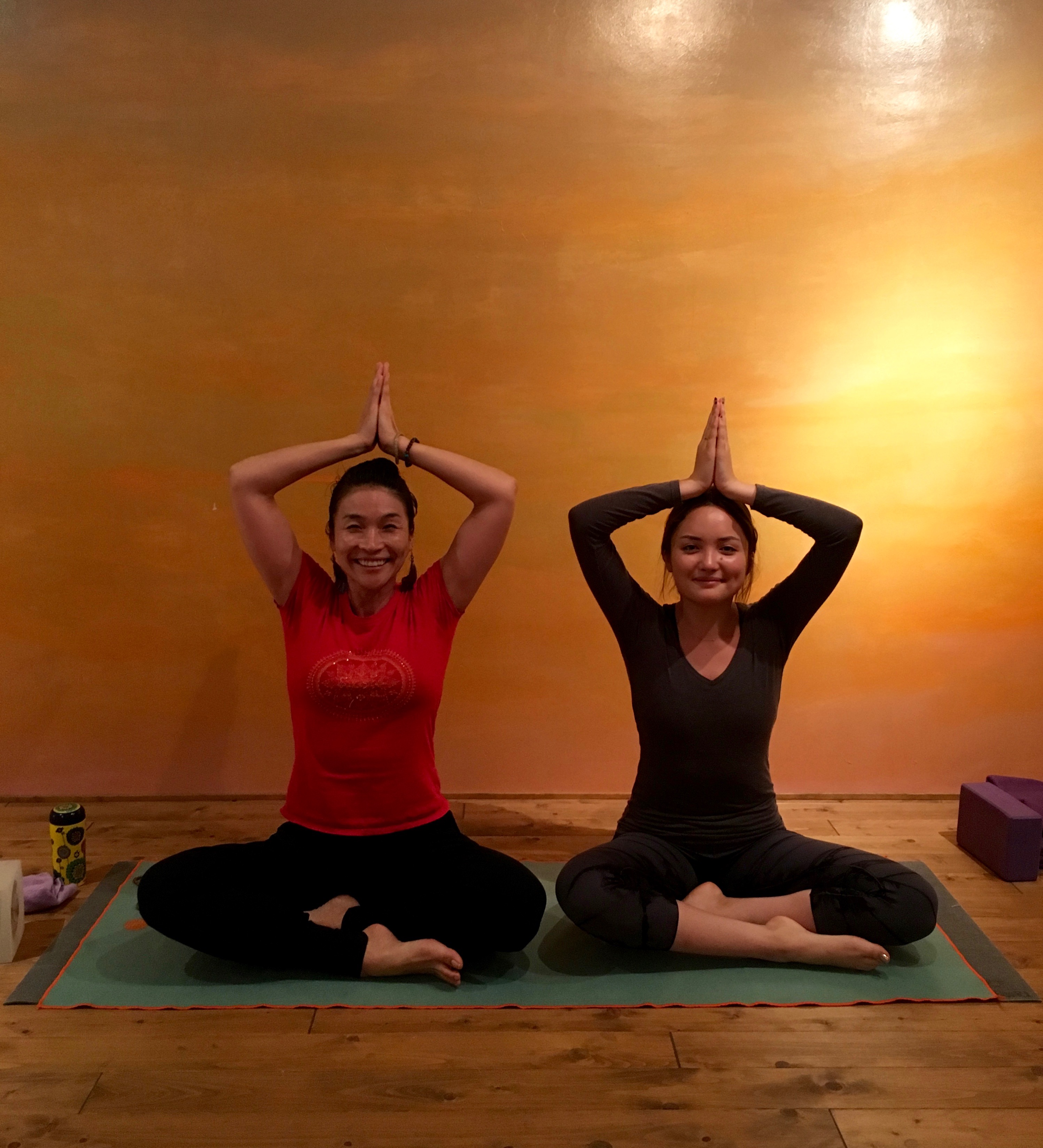
In respect to yoga, I am learning A LOT, mostly that I am as flexible as a tree trunk. Fortunately, the studio has bilingual instructors so the transition into yoga with virtually no experience hasn’t been to bad. It is also a nice change of pace, to go from being a teacher to being a regular student. Also, I’ve gotten more opportunities to practice my listening skills and silent observation as I have attempted to discreetly check the actions of my fellow yoga practitioners to ensure that I’m doing things correctly…Overall, yoga has been a great experience and I recommend it to anyone interested, regardless of prior experience.

Regina Hong : Volunteering at the Kyoto Institute of Technology Museum and Archives

One of the key reasons I had in applying to KCJS was its CIP component, particularly since I hoped to gain some experience volunteering and offering whatever skills I had to a museum. The path to obtaining this museum volunteer opportunity took some turns however; I was told that it was rather difficult to get a volunteer placement with a museum but remained reluctant to give up on this, and Professor Henry Smith, the former director of KCJS suggested that I could contact an acquaintance of his at the Kyoto Institute of Technology Museum and Archives, Namiki Sensei (the director of the museum), who offered me the opportunity to volunteer at the museum.

Every Monday, I would catch the train after lunch to Matsugasaki for a three-hour volunteer session. I worked mainly with two colleagues who arranged various tasks for me. These tasks were largely administrative; I might sort out and scan posters one day, catalogue and translate Chinese posters the other, and place letters of notification into letters for mailing on another day. One might think that such administrative tasks would not have “really” shown me what working in a museum is like, but I think that that might have been the point – the backbone of museum work often consists of simple but tedious administrative work.

These administrative tasks also provided a lens through which I could view the relationships that the museum had with their clients, and the work culture of the museum in general. Two particular incidents come to mind. The first was when I was sorting the letters notifying the museum’s patrons that there was a new exhibition on architectural models coming up when I noticed that they had been personalised, with the addressees’ names handwritten and a short line or two explaining the relevance of the museum to their organisations or interests. This was presumably done to encourage greater visitor turnout, although I think that it also highlights the care that the museum took in thinking about how to personalise these invitations. While I do not agree with essentialist descriptions of a “Japanese” work culture, I found this to be a unique aspect that I had not seen before at the other places that I had interned at in Singapore. It is unclear if this was a thing unique to museums in Japan or if it is a hallmark of museums in general but I think that it is reflective of the regard that this particular museum holds for its relationship with its clients.

The other incident was when there was a mistake with the phone number printed on one of the posters for an upcoming exhibition, necessitating the manual blanking out of the misinformation using correction tape. Although I had been assigned the task, my two colleagues worked with me, and other colleagues came over from time to time to help out. Contrary to the stiff rigidity I had been expecting, the work culture at the museum was wonderfully relaxed, with my colleagues being quite at ease with Namiki Sensei (I once jumped up to greet him when he walked into the room to speak to us but my colleagues remain seated and they began to chat casually). My colleagues took care to remind me to go for a break at 2:30 pm every session, and would offer me delicious snacks from the staff pantry. They were also keen to speak to me on a variety of topics, and always patient whenever I had any queries.

In terms of advice, I would say that, however cliché, one’s attitude in the course of a CIP activity that involves volunteering is key. To make that statement less ambiguous, I think that there are two key components to this attitude. The first is having an open mindset, and the other is being aware that it is less of what the opportunity can do for you and what you can offer it. Although I am a history major, I had never had prior experience with art history and had never thought I would work in an art museum. I admitted as much to Namiki Sensei while expressing interest in learning more about art history, and he took this into account, reassuring me that there was work I could do even with my lack of experience, such as translation. As such, I stumbled into this volunteer opportunity not knowing what was in store, but emerged from it with a new interest in looking at posters and thinking about their historical significance.

I also walk away with an added appreciation for the culture of omiyage. Bringing omiyage back from one’s travels is a very effective way of creating a conversation topic, and on a practical level, also helps feed hungry colleagues on their breaks!

Sabrina Bidus: Assistant English Teacher at Kyoto Bunkyo High School

This semester, I had the opportunity to volunteer as an assistant English teacher at Kyoto Bunkyo High School. I wanted a chance to help Japanese students with English because I understand the struggle of learning a foreign language; and luckily, I was able to help this class of students who were preparing to study abroad in Canada. They were making presentations about something Kyoto-related that they enjoy—everything from calligraphy to green tea to the Shinsengumi—so not only did I have the opportunity to help them with written and spoken English, but I also learned a lot about Japan and Kyoto along the way.
Because they were preparing to study abroad, these students were enthusiastic and willing to learn—I was concerned that I would be in a class full of kids who did not really care about learning English, but this turned out not to be the case. I was also extremely surprised to be placed in a class of high school students; I expected elementary or junior high students, but not students much closer to my age. I thought that maybe I would get more attitude, less respect, and little cooperation from some students of this age. But as mentioned before, these students want to learn English and as a result, appreciated my help. There were times when I thought the students did not want my help or did not enjoy my presence in their classroom. Again, I turned out to be wrong. These students were just a bit shy or timid, and when I tried talking to them about their presentations, they often eagerly accepted my help. Whether it be listening to them practice, helping them with PowerPoints, assisting them with their pronunciation, or fixing their English presentation scripts, they usually listened closely and the changes they made reflected my commentary.
The last day I volunteered was particularly interesting. I finally got to see the final product of weeks of practice on the students’ part. But before that, I met another group of students and helped with their class. These students had studied in Australia and likewise were very motivated. I assisted with and judged a debate the students had—about the pros and cons of the internet and smartphones! I remember having to write on a similar topic for my Japanese class back home and therefore understood how difficult it could be. After the debate, they had to make up alternative endings to fairy tales and present them. Again, I was impressed, and their humor and personalities came across even in English. My favorite story ending was created by a couple of girls who had to write a new ending for Pinocchio. They said that Pinocchio and his father were spit out of the whale’s mouth—but into another whale’s mouth! (The End.) I was also amused by an extremely vocal female Japanese student who was playful with the teacher and the JET assistant; far from being the stereotype of a quiet Japanese student, she spoke her mind and asked me multiple questions. I appreciated her enthusiasm and it was a change from my encounter with the other class, where I had to ask the students questions to get them to speak with me.
My CIP was a great experience; I only regret that I was not able to help out more. Due to the conflicting schedules of KCJS and the Japanese school system, I could only volunteer at Kyoto Bunkyo High School a few times. Yet this time allowed me a new perspective on Japanese school life and a chance to help motivated students—students who, like me, will soon be studying abroad and living daily life in a foreign language.

Alan Aquino: La Carriere Cooking School

IMG_1113

Last semester I joined a light music circle at Kyoto University. This semester however, because of final exams for the Japanese university students and their semester ending in March, I decided to pivot and instead take once-a-week cooking lessons at La Carriere Cooking School on Sanjo-Kawaramachi. I found out about the school through a group cooking event organized by KCJS during my fall semester.

Interpret this as you may, but classes are split up according to gender. Further, lesson prices are higher for female students than male students. The women have a wider selection of lessons at their disposal, while the ones that share the same content as men often have an extra dish incorporated into them. As a student, I received a generous 25% discount for my lessons from January to April.

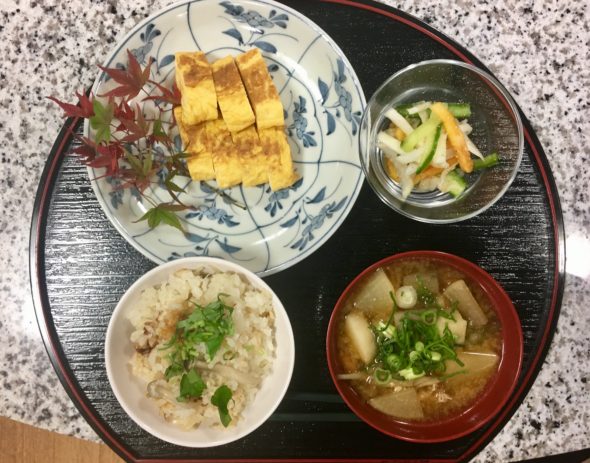
The lessons are divided up as follows: Washoku, Yoshoku, and beginner’s skills. Each month there is one Washoku class, one Yoshoku class, and two beginner’s classes. Since I cook frequently back in America, I went into the first month feeling confident about the beginner’s courses, but decidedly more nervous about the more specialized classes.

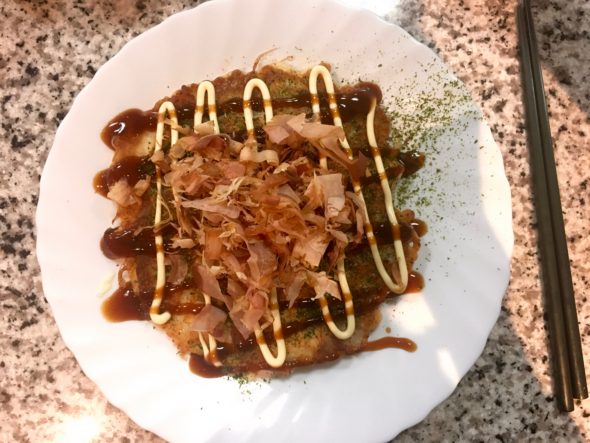
For the first lesson or two, I would arrive an hour early and painstakingly translate the entire recipe sheets for the session’s two dishes. We were then directed to our demo room, consisting of 8 workstations made for two people apiece. At the start of the lesson, the head chef and his assistant would demo the entire cooking process for the night, referring to the sheets as needed and adding personal tips along the way. We would then be let loose, and working with our assigned partner (who changed every week), we would go through the sheets together and cook, assisting each other as needed.

What I quickly discovered was that I only needed to know the names and Kanji for ingredients unfamiliar to me, while the actually procedure I could pick up by ear pretty easily from the chef. If I ever got hung up on something, all I would need to do is wave down either the head chef or the assistant chef, or simply ask my partner. Yoshoku lessons became my favorites, because they used a lot of ingredients and techniques that I was already quite familiar with back home. In addition, I developed a fast friendship with the chef that always headed those lessons, a Japanese man who cooked in France for a few years of his life. Of all the teachers I had this semester, he was the one who engaged with me the most.

I kept all of the recipe sheets that I was given, and intend to use some of them again in the future when I’m cooking for myself. Over the course of the semester, I’ve learned a great deal more of Japanese vocabulary, gotten to know some new techniques, and interacted with people from a variety of backgrounds but united by a passion for cooking.