Briana Freeman: Pottery Studio and Kyoto Cooking Circle

My CIP was the pottery studio. Catherine had the same CIP, and it was nice to have someone with which to navigate unfamiliar situations. Every Saturday I spent about five hours making Japanese-style cups and bowls of various sizes. Before, I never paid much attention to the difference in shape between Western and Japanese dishware, or the fact that most Japanese cups and bowls have a foot. Going only once a week, making pieces and getting to know people has been a slow process. I’ve made several things and given them to sensei to bisque-fire, but as far as I know none of them have been fired yet, so I haven’t glazed anything.

Starting out at the studio, I was pretty nervous. I hadn’t done pottery in about two years—and worst of all, the first day, we threw on the wheel. Needless to say, I was pretty bad; I was never very good at throwing. Someone at the studio spent that whole day teaching us how to wedge and helping us throw. I’d never seen that method for wedging clay before—the clay ended up circular, flower-like with ridges coming our from the center. And, as I soon found, it was very difficult to replicate. To this day I haven’t mastered it; I’ve had to stick to the basic wedging method I learned in high school. I’d like to learn the more advanced wedging method before the year is through, since wedging is the basic of basics in pottery.

When we’d finally wedged the clay sufficiently (one way or another), we were ready to throw. I was very surprised when the person helping us placed the entire, very large, chunk of clay on the wheel. Before, I’d always chosen a chunk according to the size of final piece I wanted to make. I’d only ever seen professionals put a huge piece on clay on the wheel, center it all, then use only the top to form a piece. This allows them to simply cut the finished piece from the top when finished, and use the already-centered clay at the bottom to make more and more pieces. I had a hard time with this method, because the more clay you have, the harder it is to center.

Slab machine

I never realized how easy we students had it in high school; there was a slab machine for making perfectly flattened, consistent-thickness slabs of clay, and a coil machine for making endless coils of the same size. At the studio, I’ve learned to make coils myself, by rolling the clay between my hands in a way I’d never thought of. Doing everything by hand seems more authentic, more traditional. I like it. (However, I have no idea how I could make a slab of consistent thickness by hand…) That being said, not everything in the pottery studio is done by hand. I’ve seen a lot of people use molds to mass produce things like cups so that they’re exactly the same. It’s fascinating, and I’d like to try it sometime.

Since the first day, I’ve stuck to what I’m good at: making pieces by hand. It is also much easier to talk to people when working at a table than at the wheel. Little by little it’s gotten less awkward, on both sides. At first the studio didn’t seem to know what to do with Catherine and me, but I think they’ve gradually become comfortable having us there. Indeed, the pottery studio isn’t some big, impersonal company, but rather has a very friendly, personal feeling to it. A little over ten people come every Saturday, and seeing some of the same faces every week is nice; it allows me to talk with people beyond just my name and the fact that I’m studying abroad.

A few times some people at the studio have commented on how I work diligently on a piece, sometimes spending hours at a time making it the shape I want. When they complimented my determination, I was happy, but surprised. In high school, where we only had 50 minutes to get out all our materials and tools, work on our pieces, and also clean up, perfectionism was a luxury that no one could afford in order to get all our projects done in time. I like that at the pottery studio, you can work at your own pace and focus on a piece as long as you want. I’m really glad that for my CIP I’ve gotten to work on pottery, which I’ve loved since my freshman year of high school, my first pottery class.

Katsu

My second CIP was the Kyoto Cooking Circle. I now realize just how hard it is to make the nightly meals I take for granted. I look forward to making some of the things I learned for my family in America. One thing about the Circle surprised me. Though there was a relaxed air throughout the cooking, after we had eaten, we did aisatsu. One by one, each person introduced themselves and talked a bit about the cooking experience of that day. The sudden formality caught me by surprise, and I wonder if similar bouts of formality are common at other kinds of relaxed events.

Emily Harper: Bazaar Cafe

For my CIP this semester I’ve been working at the Bazaar Café, a mere 5-minute walk from the Doshisha Campus. The cafe’s main goal is internationalism and the food they serve changes depending on the day and who is cooking. I often go on Saturdays where the main dish is Thai. My job mainly consists of working in the back of the restaurant with the rest of the staff, preparing meals for customers as the orders come in, bringing customers their food when it’s ready, making coffee and other beverages, and washing dishes. While not your typical CIP experience, working at the café has taught me many things including what it’s like to work in Japan, the importance of customer service, how to follow directions quickly and efficiently, and perhaps most importantly, understanding the “rhythm” of the kitchen well enough to make it run smoothly. There was no more satisfying feeling than finishing a lunch service where every order has gone from the kitchen to the customer swiftly and without a hitch (although this is often rarely the case).

Having worked in food service before, I started my CIP with the expectation that the experience would be similar to back at home. What I’ve realized is that working in a kitchen in Japan can be seen as a microcosm of the country itself. It’s amazing how from only working in a café once a week for three months I’ve learned most of the stock phrases of the formal language that anyone working a part-time job in Japan must use. I’ve learned how to cook some traditional Japanese as well as Thai dishes (all of which we volunteers get for free. Definitely a perk!). I’ve learned that especially when it comes to food, aesthetics as just as important as the taste itself.

The people who work at Bazaar Café have so much pride in what they’re doing, and that feeling is contagious. Food and drink are truly cross-cultural. And by the end of a service, no matter what language we speak (English, Brazilian, Thai, Japanese) after all the stress and group work, mix ups in the kitchen and good food, we all seem to understand each other that much more for having gotten through it together.

Deanna Nardy: Manga

Really, this was the obvious choice for me. Dragon Ball Z absolutely made my childhood, and ever since about seventh grade I wanted to become a manga artist on the scale of Toriyama Akira. Reading, writing, and drawing, have always been hobbies of mine, so the opportunity to combine all in the form of manga is inherently appealing. Since art classes that focus on manga are virtually non-existent in America though, I was extremely excited to take advantage of being in Japan.

While the choice to join Doshisha’s Manga Club and also take private manga lessons was, in hindsight, extremely predictable, the actual experience was anything but. I had never taken an art class before, so when I showed up to Okamoto-sensei’s lesson, I was extremely nervous. He wasted no time in taking apart the drawings I had prepared for him, and there were times I felt extremely dejected. For instance, when he would say things like “Your arm comes out of this part of your body,” or “The bone from your shoulder to your elbow is straight, so don’t bend it,” I would think to myself dear lord, have I actually ever seen a real person before?

Despite being strict though, Okamoto-sensei and his various assistants were all extremely open to my vision. They did not mock me for wanting to become a professional manga artist, and they supported me when my version of a hero did not line up with the archetype. Knowing how to draw did come in handy when the Japanese conversation started to falter, but I am proud of the fact that we were able to communicate deeper meanings to each other. Out of all the Japanese people with whom I’ve come into contact during this program, I would say Okamoto-sensei knows the most about me as a person. Since I often feel different when I speak Japanese, this fact is very important to me, and I count it as a valuable success and evidence of my language improvement.

The Doshisha manga club, on the other hand, proved to be a challenge in this department. Every week, I would show up to the club room and draw for at least two hours with on average 4 other people. I don’t know if it was because of shyness or not, but the Doshisha students absolutely refused to start a conversation with me. The first two times I went were awkward “Hello” and “See you next time” experiences.

If you find yourself in a similar situation with your CIP, the crucial thing to remember is to never give up. Like Son Goku, you can either break or turn Super Saiyan. Knowing that I was getting nothing out of the experience (I could always draw at home), I began to take myself out of my comfort zone and initiate conversations and email a member of the group a few times a week. This made things significantly less awkward when I showed up. The conversations weren’t long, maybe fifteen minutes out of the time I was there, but it was progress.

Next semester, I hope to continue moving forward until both CIPs can be written off as complete successes! For those of you who are worried about this requirement of KCJS, take it seriously! This is one of the most important chances for you to make real Japanese friends without all the charade of planned mingling events (which are fun in their own way, don’t get me wrong!). So pick something you love, and channel all the energy you can muster!

William HB: Urasenke

My CIP was the practice of Urasenke-style Tea Ceremony. I selected tea ceremony because the concentration of my study is Japanese history. A very important aspect of this history, particular the warring states and Edo periods, is tea ceremony. Tea ceremony holds a place, not just in understanding the Samurai class, but also understanding a uniquely Japanese aesthetic. Many of my favorite subjects of historical study, such as Ii Naosuke, were avid practitioners of the tea ceremony and in order to gain a better understand of that history, I have decided to jump in head first. The school is conveniently located several blocks from the Imadegawa subway stop and can be reached after a brisk five-minute walk beginning from the main gates of the Doshisha campus. The classes are taught in a very old machiya with three traditional tatami mat rooms and a small kitchen nestled in the back. The first room is where people leave the belongings while they are in class. They then walk to the back room and take up seats on the edges of the room. Sensei sits at the front of the room, in seiza, facing all of her students, who are also expected to sit in seiza. There were two tea-making stations in this room. Two different set-ups where advanced students would come into the room, lay down their materials, heat the water, and make the tea under the watchful eye of sensei.

I attended class twice per month and each session was two hours long. For the first 30 minutes I would sit in the back room, watching while the advanced students practiced their art. Sensei would choose one of these advanced students to serve me a round of tea and sweets. Then, I would go to one of the other tatami mat rooms with an advanced student who would serve as my assistant teacher and show me the basics of Sado. Thus far, I have learned how to enter the tea room, how to open and close the door, how to walk to my place, how to sit down and stand up, how to fold a cloth, and how to use that cloth to clean a tea caddy. This session takes up the remaining hour and a half of the time. In the future I hope I will get to demonstrate some of these skills for sensei. Before leaving, I am treated to a more informal round of tea and sweets in the front room, where I practice. Sometimes, when there are too many students for the advanced students to serve, someone will go to the kitchen and make tea with a water heater. Finally, we have been taught how to clean tea cups after an informal tea service.

I have really enjoyed my time practicing Sado. As an art, Sado is possessed of a cavernous depth that cannot properly be explored in the time I have. For me, Sado has served as a source of relaxation and focus. Making slow, methodical, precise movements and cementing them in my muscle memory is time consuming, and sometimes frustrating, but each small success is rewarding. It is difficult to retain some of the learned processes, however, because I only attend twice a month. The tea class I attend is so popular that sensei’s schedule only had room for two more monthly sessions. As unfortunate as this is, I feel grateful to have spent as much time there as I did. Sensei and all of her assistants are extraordinarily hospitable and kind.

They have accommodated my bumbling gaijin ways and limited Japanese ability at every turn and provided an excellent environment in which to learn and grow. Not only have I been able to improve my Japanese vocabulary and make new friends, I’ve been able to immerse myself in a crucially important piece of Japanese culture and better understand its place in Japanese history.

Ha Min Kim: English Volunteer

Volunteering for helping with English education at Kamigyo Middle School has been good. This volunteer position requires me to help two pupils who are preparing for the English speaking contest. Mostly, my task is to correct them on pronunciations and evaluate the way they give their speech. I decided to give this volunteer a try, because I wanted to place myself in a position where I get to see non-native speakers of English working hard to polish their English. From this experience, it is clear how difficult English language is for the Japanese students. When a student struggles to pronounce the simple word such as “born,” it reminds me how I struggle with using simple words in Japanese. In the same sense, KCJS students also find learning Japanese difficult as well. Foreign language study is a huge challenge that a student takes, and ever since I started learning my first foreign language, I always wondered how to successfully learn a language.

One thing I have learned from the CIP experience is that speaking in foreign language is an uncomfortable task that is usually not approached through the students’ interest. Mimicry is my hobby; thus by doing so, I try to keep my foreign language study to be as amusing as possible. However, I feel that the students I am in charge of at the Kamigyo Middle School practice their speech for the mere speech contest. One of my students said that he does not like one of his stories he has to recite by memory. I feel that foreign language must be accompanied with the students’ interest that serves as the incentive for the study of that language.


Denton Williams: Assistant English Teacher

Before I came to Japan, I knew that I wanted to teach English for my CIP activity.  When I finally arrived in Japan and started the CIP process, I encountered no difficulty in deciding where I was going to teach; everything was easier than I could have hoped for and KCJS already had well-established connections with schools.  I started to hit a few bumps in the e-mailing stage, but only with respect to waiting for responses.  So, after practicing my written 敬語 for the first time in Japan, I finally started my dream CIP of teaching at Kaisei Middle School (開晴中学), located near Kiyomizu-dera.

As I explained in my first, Japanese blog post, teaching on my first day at Kaisei did not start out so smoothly.  The seventh graders, contrary to my ideal expectations of Japanese middle school students, were incredibly raucous and disrespectful to their teacher.  Throughout the entire fifty minutes some of the students did not stop talking, and others were running around the classroom or sleeping.  To my greatest surprise, however, was that the teacher did absolutely nothing about the chaos.  I stood in the crowded classroom, jaw-dropped, and waited for her to explode in a disciplinary rage at any second.  I myself considered telling one or two boys to sit down and be quiet, but before I knew it the clock struck 3:20pm and the students were free.  When I returned home after my first day, I thought to myself, Do I really want to teach here?  Can I actually make a difference in this kind of hopeless environment?  Luckily, I decided to do my best and be patient, and I am extremely glad to write that I am thankful I hung in there.

As the weeks of my study abroad experience passed by and I commuted every Monday to Kaisei Middle School, the classroom setting seemed less and less harsh.  I acquired a second class to teach as well, meaning I could practice my week’s teaching with better-behaved eighth graders before facing the rowdy pupils of room 7-2.  So, each week I asked individuals questions in English, helped answer students’ questions about worksheets etc, and tried extremely hard to encourage students to participate.  Eventually I started practicing my Japanese as well by trying to better explain things to students who were not as skilled at English.  Meanwhile, little by little I was becoming more familiarized with who the students were and the dynamic of their relationship with the teachers.

This leads me to what I gained the most from my CIP.  Contrary to my original dream back in the United States, I did not learn how to fluently speak Japanese and teach angelic, diligent middle schoolers how to speak English.  What I did learn, which falls in line with my personal theme of studying abroad with KCJS, is that there is way more than meets the eye during first encounters.  The Japanese students were incredibly unruly the first time I met them, and they proved to change very little week after week.  However, every time I spoke 「英語アシスタントでございます」through the gate’s doorbell and stepped foot into my slippers at Kaisei Middle School, I was about to witness the students surprise me in some way.  I started to see that some of the most misbehaved students were actually the ones who were participating the most, albeit in decibels higher than what is safe for human ears.  Furthermore, I saw that many of the students truly cared about learning English, and even more so about learning in general.  They were excited to start class with personal questions for me in English, and they always asked their teachers to chat with me in English so they could observe.  I quickly came to realize that I misjudged my students on week one, but I was happy that this was so.

The CIP component of KCJS may seem like another task on a checklist of “things to do,” but it actually was a crucial part in making the theme of my time abroad become whole.  Teaching English at Kaisei Middle School helped me learn even more not to judge people based on first impressions, stereotypes, and preconceived notions.  It taught me that everyone needs an extra chance or dose of attention in order to see his or her true personality and potential.  Upon realizing this, I was able to conclude that while Japan’s culture and language are very different from that of the U.S. in many ways, the people of each country are at the core very much the same.  I truly hope that I was able to teach many students at Kaisei Middle School, or maybe even just one or two.  However, I can say with conviction that I entered the building as “Denton-sensei” determined to teach English, but I will be flying back to America as a student who was taught the universal language of life.

Alexa VanDemark: Koto Lessons

For my CIP in Fall 2013, I chose to take private koto lessons. Naturally, I’ve learned a lot. The point of the CIP to begin with is to involve yourself in the Japanese community, hopefully learn some keigo and Japanese culture, and have fun in the mean time. I can say without hesitation that I have been enjoying my lessons. Like any other instrument I’ve played, there is a learning curve. You have to learn the correct posture, positions for you hands, musical notation, the list goes on. When you do something new, you naturally make mistakes, so you probably get frustrated from time to time. Put that pressure on top of learning that new skill in a different language and having to explain what you don’t understand in that same language. Oh, and don’t forget to use keigo! Despite the pressures, I have learned more than I had originally anticipated.

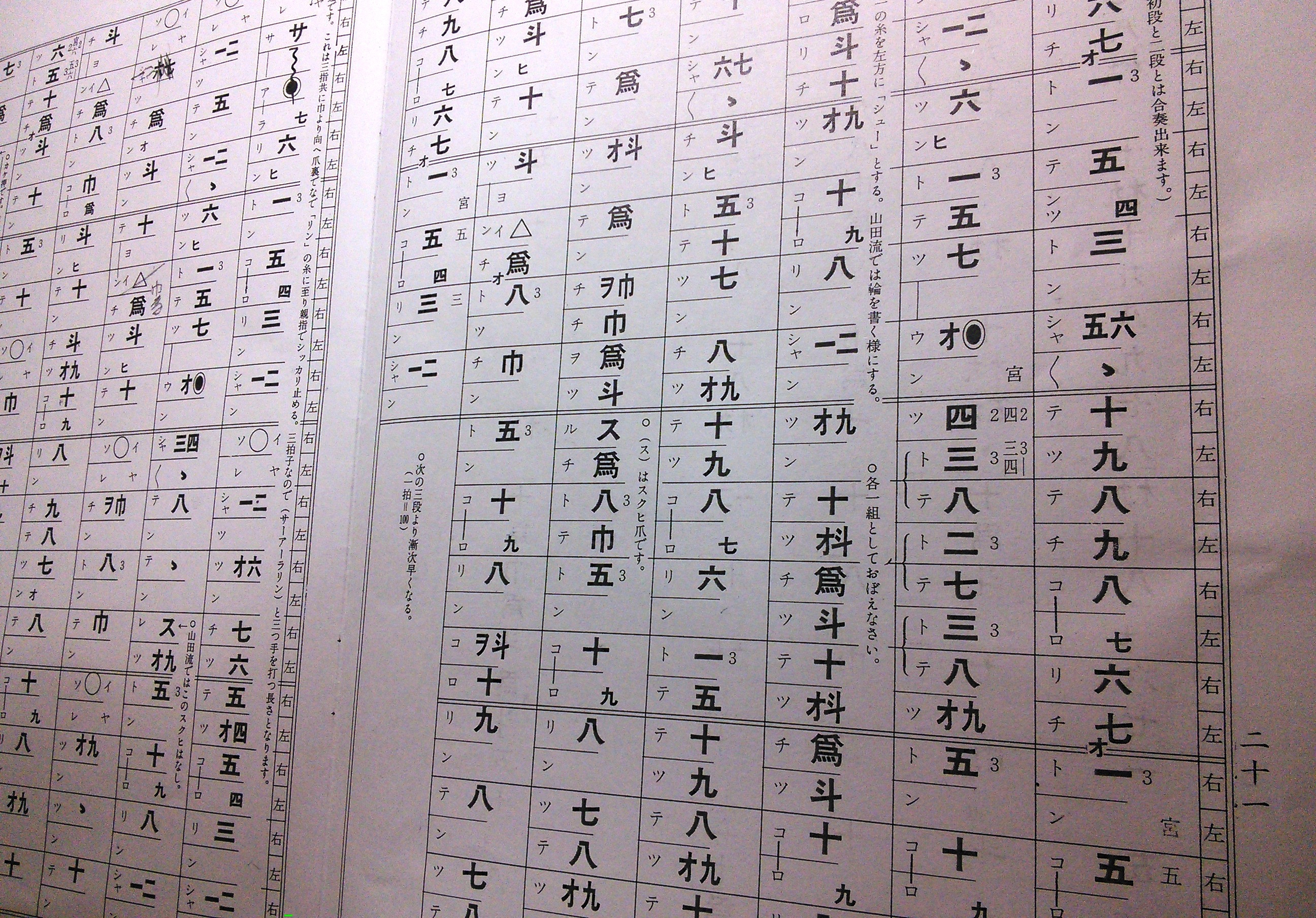
Rokudan no Shirabe sheet music

Sheet music for the song I’m currently learning. Reading music vertically instead of horizontally is the hardest hurdle for me to jump over at the moment.

More than anything, it’s only too easy to create a list of all the faux pas I’ve made in one semester and how to not repeat them in the future. For instance, I spent the first few weeks being a regular Floridian and wearing flip-flops to my lessons. It was hot outside! The problem was that my lessons are held at my teacher’s house, in a washitsu. It hadn’t occurred to me that by not wearing socks, my dirty feet were seen as a social taboo in the traditional setting of koto lessons. Noda-sensei never said a thing, but I was mortified when I found out from someone else that what I had been doing was quite incorrect. And up until a few weeks ago, I had been cheerfully saying, 「お疲れさま!」after Noda-sensei said it to me. I learned not to do that after a linguistics class in which we discussed that is just not something you say to a teacher. Even after I feel like I’ve learned so much, every week it seems I find something else to correct!

However, that in of itself is rewarding, because at the next lesson, I can walk in confidently, amassing all of the formalities and aisatsu I’ve accumulated over the semester. I can return the sheet music my teacher and know how to politely thank her for lending it to me. I can attend her concert and know to bring an omiyage in congratulations. I can laugh when I get lost in the unfamiliar sheet music and ask to start a passage over, and it’s comforting when she laughs too, and agrees. It was difficult doing a CIP where I had to solely communicate my questions and such in a language that I’m still learning, but through these lessons, I come into contact with an elegant side of Japanese culture that I would not have touched otherwise. I’m looking forward to continuing this immersion next semester, while learning more How-Not-to-Be-Act-Like-a-Gaijin pointers as well as beautiful music.

Romana Perez: Niconico Tomato

For the past few months I have been volunteering at Niconico Tomato, which is a program that tries to bring smiles to the children at Kyoto University Hospital. We do things like prepare events, organize parties, make gifts, and generally have fun.

For Halloween, and now for Christmas, we make cards for the children. I really enjoy trying my best as I make the cards, since I know the child who receives it will appreciate it. I also enjoy the creativity the volunteers put into making the designs. For the Halloween cards, we embroidered a spider web into the card, attached a ghost, and created a foggy spooky background. I think they look really cool. The Christmas cards are going to be just as well thought out.

I’ve also enjoyed talking with the other volunteers. We tend to talk about the differences of American and Japanese culture. Everyone in the program is extremely nice and it’s easy to talk with them as I work. Interacting with the kids is also rewarding. Even though the children are sick, they still have so much energy and are able to have fun. I find it amazing that the little activities we create for them, like collecting a sticker every day they visit the playroom, keeps their spirits up. I really do believe we are doing a good thing at Niconico Tomato.

James Mellody: Klexon English Language Cirlce

My time volunteering at Klexon English Circle has been a culturally enlightening and entertaining experience.  Through the circle, I have come to meet a lot of interesting Japanese people, mostly students from various universities in Kyoto.  The actual CIP itself consists of speaking in English for two hours each Tuesday with various Japanese people in the circle.  For the first hour, I talk with several people one on one for about 10 minutes each.  For the second hour everyone breaks up into small groups and talks about various topics.  This allows for a more natural conversation to develop.  After the two hours are over, Klexon members often go out in a more natural social setting.  This is where I really get to talk to the members and get to know them.  At Klexon we speak all in English, but when we went out we spoke in a mix of Japanese and English, the goal being to use whichever language best facilitates communication.  To me, learning a language in a classroom setting can often feel forced, but actually using language in a real setting was exhilarating.  More than practicing language, we were trying to have real conversations.  I also noticed that the atmosphere became much more casual and people became more open and willing to talk.

I also went to two parties held by Klexon.  At first I was unsure of how to initiate conversation – whether it should be in English or in Japanese.  After a little while, however, people began to engage me in conversation.  While they spoke to me in English at first, people started to speak to me in Japanese as they became more comfortable.  The structure of the language they used matched the informal setting of the party.  They used more informal speech patterns, which immediately helped to make the environment friendlier.  In this casual environment, I managed to make some friends that I have since seen outside of the circle.

When first talking to a Japanese person, I would informally introduce myself.  We would then proceed to talk about very basic personal information.  This type of introductory conversation is very similar to that used in America.  I did not, nor did the Japanese people around me engage in the formal introductions common in many situations in Japan.  The more informal setting of the party eliminated the need for such formality.

These parties had no music or dancing, but were instead dinner parties in which we sat, ate, and talked together.  Parties at my college in America are usually extremely loud and filled with people dancing rather than talking.  The Klexon party had a completely different atmosphere.  These parties were not just places to have fun; more importantly they were places to get to know each other.  This is different from many American college parties where the objective seems to be having fun, not necessarily getting to know new people.

I have found that it is hard to find opportunities to really sit and have a conversation with a Japanese person, so Klexon has been great in that regard.  Klexon allowed me to experience how Japanese people socialize.  It was also fascinating to see how Japanese people interact with a foreigner in a social setting.  Initially, most people were slightly shy when talking to me, but as we talked they opened up and became much more willing to initiate conversation.

Klexon has been a wonderful experience.  I have had the opportunity to meet and talk in depth with many Japanese people. I am extremely glad that I picked Klexon as my CIP, and I would recommend it to anyone in the future.

Anna Andriychuk: Bazaar Cafe

Volunteering at the Bazaar Cafe has been a very rewarding experience for me. Even if this were not my CIP, I would enjoy going there to study or have coffee with friends. The atmosphere of the cafe, whether one is experiencing it as a customer, a volunteer, or both, is really what won me over. It is such a warm, friendly place that you cannot help but feel welcome. I’ve noticed a really strong sense of community, both among the staff, and with the customers as well. Week by week, I’ve come to recognize many regulars, some of whom even stop by Fridays or Saturdays as well. There appear to be genuine friendships between those customers and our barista/manager, who I always see sharing personal anecdotes and jokes. One regret of mine is not having put more effort into interacting with the customers, which is something I would highly recommend to future KCJS newcomers.

My conversations with the staff, on the other hand, have been both fun and a great learning opportunity. The staff are some of the nicest people that I’ve met in Japan, and so I never have to feel uneasy if I make mistakes on the job (embarrassed, yes). One thing that I’ve noticed is how some of the staff call the manager “Tsu-ki,” instead of a formal Tsukishita-san. That really shows, in my opinion, not only the warm and casual relationship among the staff, but the humility of the cafe’s owner.

The international character of the café is also a refreshing change of scenery. Although the staff on Thursdays when I work is mostly Japanese, those who work on Fridays and Saturdays hail from various parts of the world and the cuisine reflects that diversity. I’ve also had the opportunity to meet a number of interesting customers, including Doshisha students, professors, and tourists from various countries. Thursdays have become quite an interesting and unpredictable part of my weeks here in Kyoto.