ナタニエル・スラトー:和太鼓とパルクール

去年の九月から、CIPのためにふたつの活動をしている。高校生のときからドラムに興味があるので、太鼓会に入ろうと思った。そして、大学に入ってからパルクールというスポーツに凝っているようになっているから、日本にいる間に続きたいと思ったからパルクールがするグループを探そうと思った。

「神若会」というのは、京都の北野天満宮の太鼓会ということだ。普通の太鼓会と違って、神若会は学生か会社が支えるグループではなくて、神社が支えて社会人で構造されているグループだ。ということで、神若会の練習の仕方や雰囲気は他のグループと違うと思う。性別、立場、年齢、経験を問わず、誰でも参加できる。たくさんの人(もっといい言葉がほしい、家族が三つ参加する)が家族として参加している。練習やイベントは二週間に一回ぐらい北の天満宮にある。太鼓は神社に納められて、練習の際に、みんなが一緒に出したり片付けたりする。みんなは練習に行く前に自分の役割を練習するのが普通だけど、新しい曲があればみんなと一緒に習うこともある。イベントは、交流会や演奏などがある。先学期には、3~4回ぐらいみんなと一緒に演奏できた。今年もお祭りで演奏する予定もできているらしい。

「Nagare Parkour」・「流れパルクール」というのは、関西地方のパルクールというスポーツのチームで、日本のパルクールのコミュニティーを建てるために、二週間に一回ぐらい大きな「ジャム」という会を行っている。大阪城公園や、大阪の鶴見緑地公園など、いろんなところで行っている。こういう「ジャム」というイベントで、「流れ」のメンバーは初心者のためのセミナーをして、パルクールの基本的な動きや一般的な考え方を教える。それから、みんなが30~50人ぐらい自由に練習したり、話し合ったり、遊んだりする。ちなみに、今週末も大阪城公園でジャムがあるから、楽しみにしている!


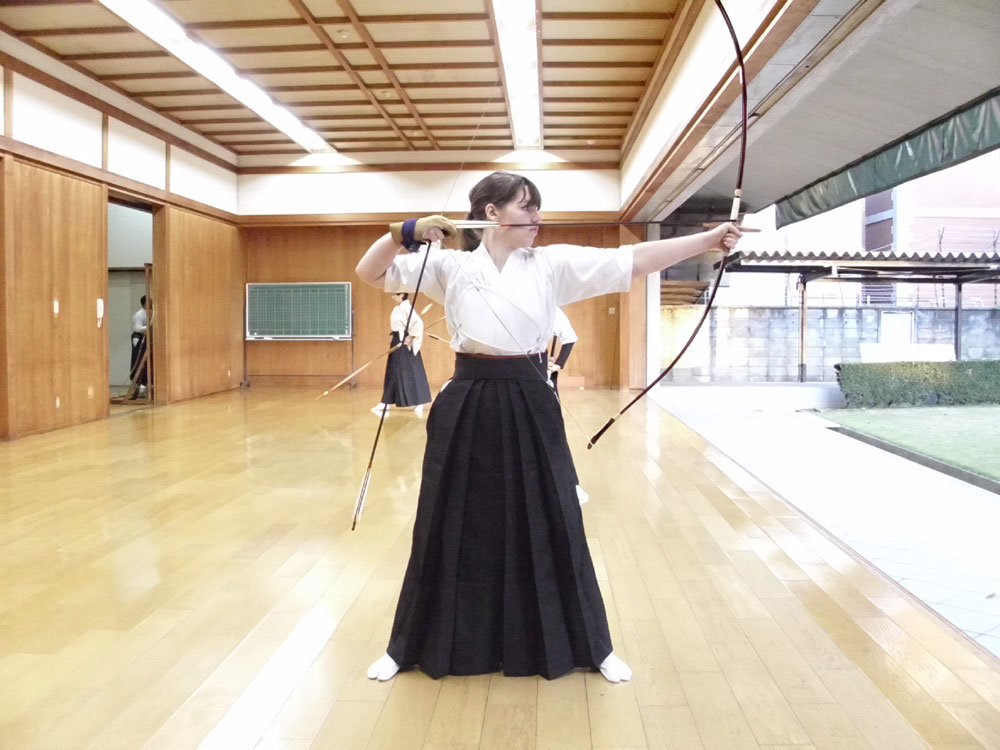
Courtney Crouch: You shoot with your Soul

Looking back, I remember deciding when I submitted my application last year that if I had the chance to come to Japan, I wanted to learn kyudou (Japanese archery). I would like to say that actually being here and being actively involved in a kyudou group is different from what I expected, but the truth is I never really had any expectations. It was just my community project, after all. However, kyudou has in many ways defined my experience here in Japan.

Perhaps most importantly, kyudou club was one of the few places in Japan where I felt like I really belonged. It is easy to feel like a gaijin (foreigner) in Japan, in part because one clearly looks different, but in greater part because, in my case, I understood only around half of what was said to me and closer to a tenth of the cultural concepts underlying Japanese life. In my kyudou club, though, before I was a foreigner, I was a student. If the rigorous traditions of the sport seemed alien to me, they were strange to the Japanese students as well. Moreover, the more I saw of those rigorous traditions the more I realized I was seeing an older framework on which the entire society appeared to be based. Having the uniform meant expressing a certain level of commitment, and by extension, truly entering the club. Once a part of the club, one’s education became the responsibility of all of its members, and so I was taught to bow properly, give greetings, excuse myself, and so forth. The deeper I delved into kyudou, the more life outside of the sport made sense.

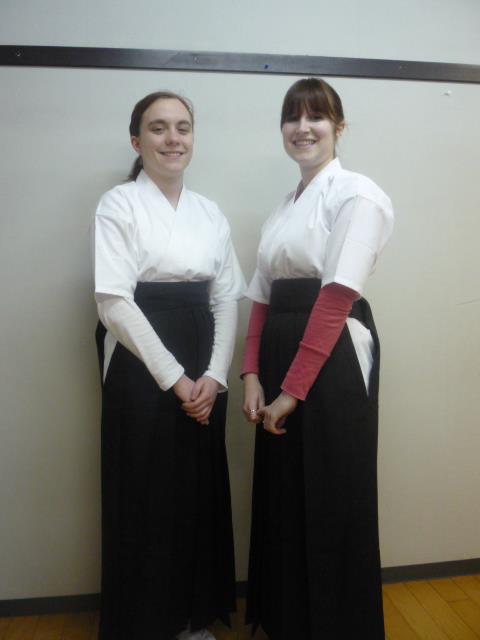
The structure of the club itself also uniquely gave it a special place in my life. It consisted in large part of people older than me, middle aged or slightly older, with a few younger individuals who largely came in the evenings towards the end of my stay, and the sensei (teacher). Perhaps for this reason and since I inevitably knew no one’s name, I was mostly called ojō-san, meaning young lady. Foreigners looking in on Japanese society tend to use the word “family” to describe the various social organizations, and I would apply the same word here without hesitation. We were in many ways a family. When I first wore my kyudou uniform, most people came to congratulate me on the fact that it suited me well. Afterwards, they would occasionally fix me if I came in with my collar mussed or some tie misplaced, and took great glee in telling me to bicycle home without changing because “all the young women in the club do it that way.”

Moreover, their attitudes towards my quirks and successes were those of a family. The women tittered when I put on my knee boots beneath my hakama, and everyone together found their daily amusement in watching me drag five-minute conversations into thirty-minute ones due to a variety of comical misunderstandings. Everyone watched when I fired my first arrow at the outdoor targets, and everyone managed to somehow hold their laughter until I finished the entire ceremony after my arrow rebounded off of the roof nearly the entire 150 m back to the stage. Finding that I had a tendency to stuff my clothes into a paper bag at the end of the day, sensei found me a suitable cloth to bundle them into. Indeed, whenever I lack something, someone tends to show up with it in hand, and even now I worry that she will next show up with a pair of traditional sandals (I insist on wearing flip-flops).

I would like to conclude with some advice, perhaps, to anyone else who thinks they might be interested in kyudou; throw yourself in head first. I, being the oddball that I am, wore my uniform to school, and even added a kimono beneath it just for fun. I was embarrassed and nervous at first, but I was also proud. Learning Kyudou was never just about learning to hit a target with a bow and arrow; it was about the form, the mindset, and the people whom I stood beside as I released my arrows. I frequently stayed late to practice afterward when I could, since the stage cleared and the club quieted down as darkness fell. At that point I could relax before heading home for the night, and the sound of snapping arrow strings and nighttime insects will forever color my thoughts of the long winter evenings in Japan.

ナタニエル・スラトー:和太鼓とパルクール

来日にあたって、日本の文化か伝統に関して新しいことが学べる活動をCIPとしようと決めた。来てからすぐ、先生のおかげで北野天満宮の和太鼓グループの責任ŽÒの野々口さんに連絡できて、KCJSの他の二人と一緒にそのグループに参加し始めた。今まで太鼓練習会一回と交流会一回しか行‚¯なかったが、その経験で、そのグループと太鼓の練習が大分好きになった。本当に様々な人が和太鼓を叩く。子供も親も学生も働いている人もいるので、練習会はとてもにぎやかで雰囲気がいい。北野天満宮の太鼓グループは一週間に一回北野天満宮で集まるはずだそうだけれど、今まではそうではない。後でもっと定期的になるといい思う。

北野天満宮の太鼓グループ二週間に一回僕が好きなパルクールというスポーツもしている。まず気づいたのは、無料でスポーツができる所が京都で見つけにくいことだ。加えて、はめずらしくて日本では社会的に大丈夫かなと、最初はちょっとた。しかし、関西地方のNagareParkourというチームを見つけ9月から一緒にパルクールをしている。NagareParkourは二週間に一回大きな「ジャム」という練習会をしている。その練習会には色々なレベルのパルクールが好きな人が集まる上に、初心者のために小さいクラスもある。大阪城公園や京都西京極公園に行ってパルクールをした。

たったの6週間の間に、たくさんの体験ができて、二つの楽しくて優しいグループを見つけることができて本当にうれしい。アメリカに帰るまでこの傾向が続くといいと思う。

コートニ・クローチ:弓道 

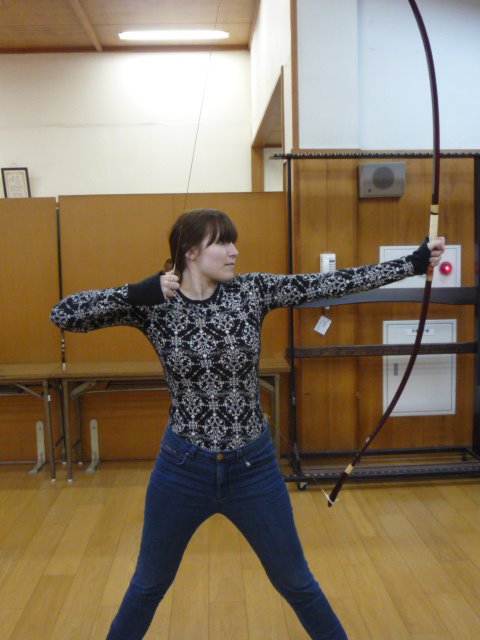
昔から日本人は弓と矢を使う弓道と言うスポーツを練習してきた。元は戦争か狩りをするためだったが、今もたくさんの人が弓道をしている。それは、体にいい運動だし、日本の伝統的なスポーツだし、大切なめいそうのし方である。弓道のゆっくりした動きのおかげで、「どずくり」と「うちおこし」と「かい」と言う形がわかりやすいから、外国人も興味をもってきたのである。

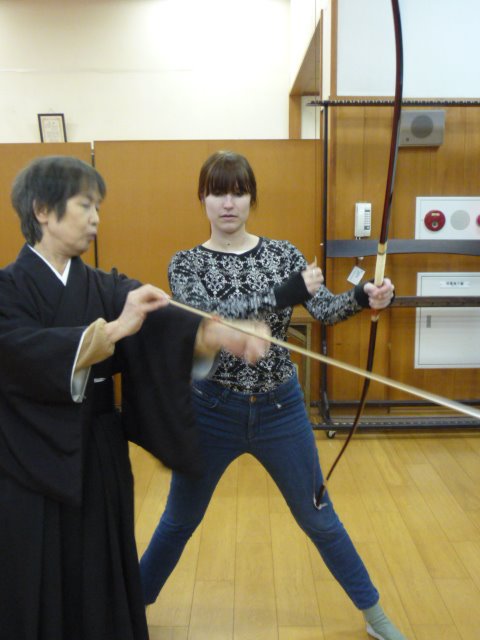
まず、京都に着いたばかりの時に弓道を練習し始めた。そして、練習が一週間に二回ある。普通、始める前に先生にあいさつして、正座をしている間に礼(れい)記(き)射義(しゃぎ)をあんしょうして、おじぎする。それから、ゆがけと言うてぶくろをはめる。練習はまきわらと言うわらの的を繰り返している。でも、いるのは矢をはなすことだけと言うわけではない。せいしゃせいちゅうと言う考え方があって、つまり完璧にいったら、矢がいつも的にあたると言う考えだ。弓道はゆっくりだから、分かるようになれる感じがする。アメリカでしたスポーツと比べて大変違うので、面白いと思う。

京都武道センターで練習しているので、他の弓道の生徒はいろいろな人だ。年上の30歳、50歳ぐらいの女の人や男の人が普通なので、私はいつも「~です」とか「~ます」と使っている。話している時に時々分からないが、その生徒たちは優しく我慢強い人ので、大丈夫だと思う。多分、いつか弓道をできるようになって、皆さんと友達にもなれると思う。がんばります!