Logan Ruzzier: Curatorial Volunteering at the Kyoto Institute of Technology Art Museum

My CIP at KCJS was volunteering at the Kyoto Institute of Technology’s Museum and Archives. During my ten-odd 2-hour sessions, spread evenly through the Fall, I engaged in a wide variety of art historical and curatorial activities for the museum. These activities spanned the realms of posters, architectural plans, and fabrics. I worked hands-on each session with one of three staff members, who each specialized in one of the aforementioned fields. I helped prepare artworks for display, measured and organized them within the archives, and even worked with graduate students to get exhibit rooms in order. 


My advice to you is to seize upon this opportunity if you are seeking the following from a CIP:

  • 1-on-1 relationship building in an apprenticeship-style role
  • Consistent exposure to uncompromising, workplace-level and instruction-oriented Japanese 
  • Conversations on any topic of your choice with highly knowledgeable, passionate academics (contingent only on your will to ask and ability to understand)
  • Above all, the chance to gather diverse and esoteric art historical knowledge through real objects, as well as the responsibility of handling them


This is very much a project that returns what you give, so I recommend that you arrive at the museum each time hungry to help out and learn as much as possible.

Nell Di Bona Beck: Calligraphy

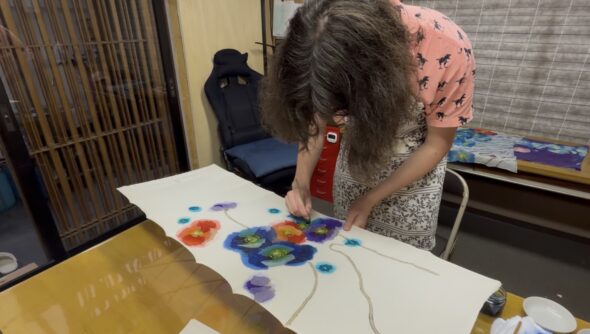
During my time at KCJS I chose to take semi-private shodō, or Japanese calligraphy, classes. My teacher, Tanaka-san, is a professional calligrapher and he guided me during this time. Some of the things I learned was how to position my arms, both the one holding the brush and the one not, how to control the amount of pressure I exerted, how to manipulate the brush to move how I wanted it to, how much ink I needed, and most importantly to never stop the flow of the brush as it glided across the paper. There is a lot more to the world of shodō than simply painting the characters, you must write with intention and meaning. The type of brush you use, the style of writing, and where you position the characters on the paper are also important in conveying not just the meaning but the feeling to the viewer. I recommend incoming students to put themselves in challenging situations–situations where they will encounter new things, or listen to Japanese above their level, or have to speak to strangers. Tanaka-san communicated with me in broken English and Japanese in order to teach me shodō because he wanted me to learn and no language barrier could change that. As long as you show that you are actively trying and putting effort, there will be people willing to help, and you in turn with grow.

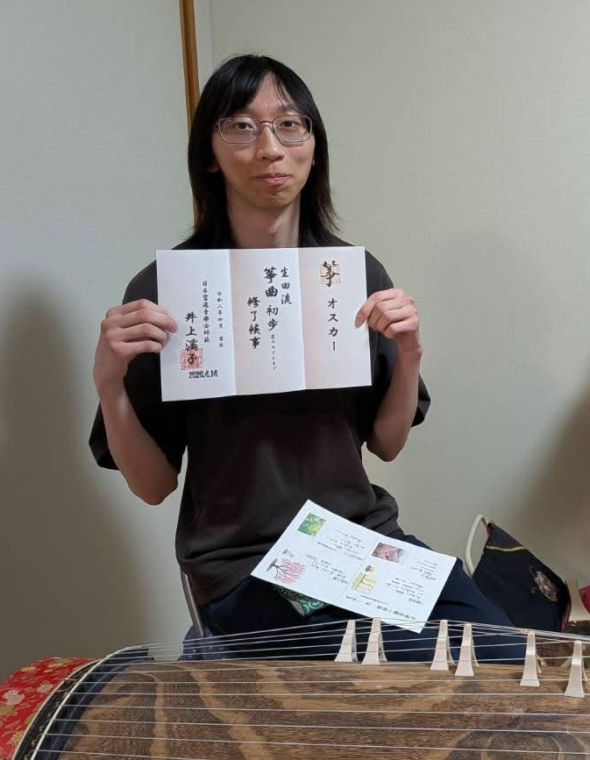
Brian Ramon-Miron: Koto Lessons

This semester I took one-on-one koto lessons under Kurahashi Sensei. For the duration of nine weeks, I took classes once a week with Kurahashi Sensei and learned different techniques and ways to play the koto, while also learning how to play various song with these different methods.

Each class would build upon the skills that I have already had or have learned in the class prior, and would continue to advance in playing more difficult song. I would definitely recommend taking koto classes, the one-on-one focus definitely helped me to understand new vocabulary, techniques, and have any questions answered while playing.

A word of advice I can give is that it is ok to make mistakes while playing! Different techniques require different ways to play the koto, be prepared to pull strings in different directions and methods to create classical yet stunningly sounding notes in traditional songs!

Sam Kirkconnell: Kyudo at the Kyoto City Budo Center

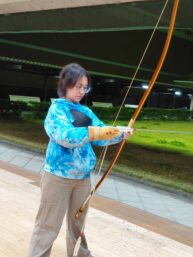
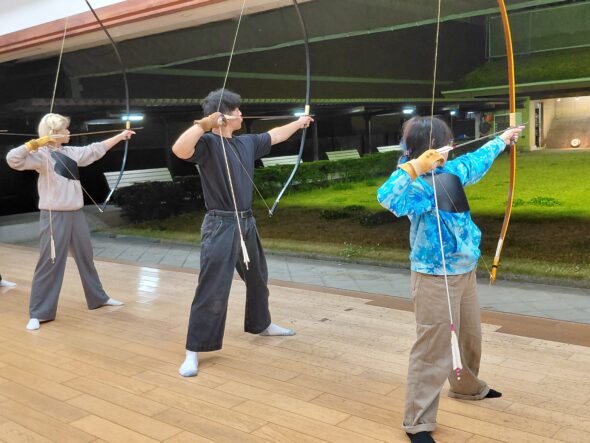
Kyudo is a Japanese martial art of longbow archery, which incorporates rhythmic movement with fluid marksmanship, achieving the spiritual state of inner peace and the mindful act of shooting its target. In Kyudo, there are eight essential steps you perform before you shoot the target, and there is a heavy emphasis in taking time in learning each step as masterfully as you can before you can even pick up a bow.  A lot of patience is required in order to not only achieve a well-rehearsed performance but to also see the merit and enjoyment of Kyudo. As stated before, a large part in practicing Kyudo is being able to observe the instructions the Kyudo sensei is able to give and being able to apply the correct techniques in order to have a smooth performance with a zen mindset.

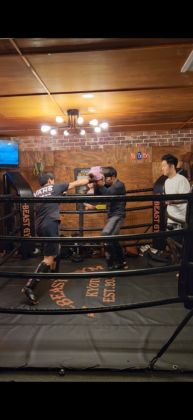
Colin Dunn: Futur Boxing Gym


For my CIP activity I elected to join the Futur Boxing Gym by Muratamachi Station. By signing up, you get access to all the gyms facilities throughout the week, with instructors on standby to adjust your form, give you tips, help you run drills (like pad work), and assist you in getting acquainted with the training area. I had a great time not only training with the coaches, who were always enthusiastic and eager to help, but also using the sport to bond with others over a shared admiration. If you watch combat sports, it can be a fantastic way to break the ice with some of the other people training there. My advice for anyone interested in boxing gyms is to be confident when approaching someone to practice Japanese. Because of the nature of the gym, people probably won’t just come up to you to talk, it’s up to you to make the first move. However, if you do overcome some of the awkwardness, it can be an extremely rewarding experience both physically and linguistically.

Tamar Feinland: Volunteering at the Kyoto Animal Protection Center

I decided to volunteer at an animal shelter for my CIP. I mainly took care of the dogs, and the members at the center would teach me how they walked, trained, bathed, and played with the dogs, as well as how they cleaned their enclosures.

I was able to interact with the other members quite a bit, as we would always take care of the dogs together, so if we were playing or walking them then I was able to engage in conversation with them. I also really enjoyed spending time with the dogs, and it was clear that the people at the center cared a lot about each of them.

I would advise future students to try starting a conversation with the people at your CIP. I was always nervous that maybe the other members wouldn’t want to talk to me because I’m a foreigner and my Japanese is far from perfect, but whenever I worked up the courage to ask them a question about themselves or the dogs we would always end up having a nice conversation, and it was a great opportunity for me to practice Japanese and connect more with the culture.

Ilya Solovjov: Theatre

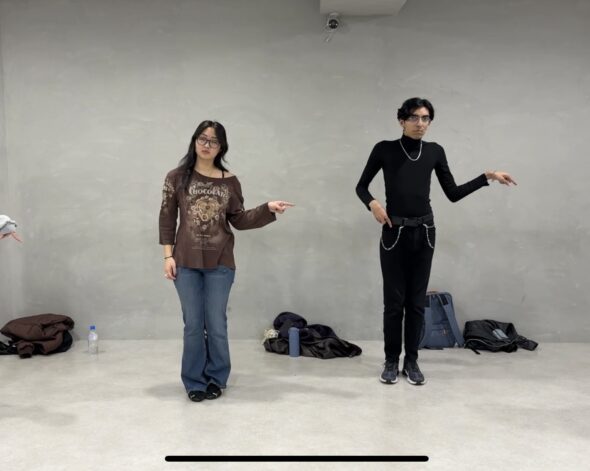
'あなたの”はたらく”を想像してみよう' performers acting during a rehearsal of the show.

‘あなたの”はたらく”を想像してみよう’ performers acting during a rehearsal of the show.

For my CIP, I took a part in a community program that involved meeting over the course of three months to talk about working and then taking part in a performance at the end of the program. The performance was like documentary theatre in which everyone talked about their own experiences or thoughts about working, in their own words.

My CIP was really difficult, especially at the beginning, and left me confused a lot of the time. It was hard being part of a group conversation in Japanese so I was often confused. But, I’m so glad that I kept going because performing and getting to know the other participants in the program was incredibly rewarding and I felt like I grew so much – both in Japanese ability and personally.

This activity required a high level of Japanese, and an ability to keep going and trying to be open to interacting with people a lot. It will probably be very difficult, but I recommend that you try to be as open as you can to meeting knew people – just saying hello and asking them about their week will help so much, even if it feels like you’re out of place. This program benefits so much from discussing your opinions and experiences, so if you share them, they will truly make a difference.

Jake Korde: Stargazing At Doshisha University

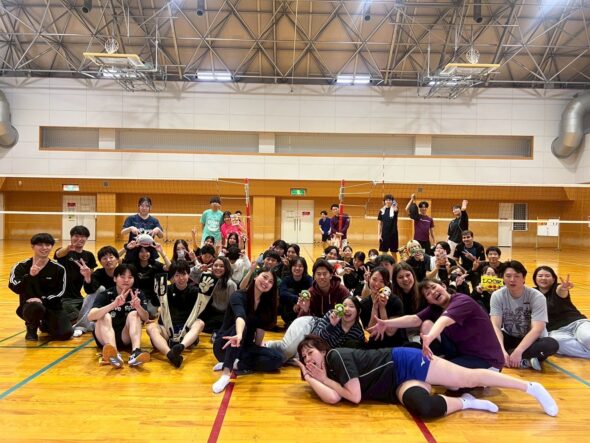
This semester, I joined a stargazing circle at Doshisha University. The activities ranged from field trips to see meteor showers, to selling fried ice cream at the school’s anniversary festival. There were also several days where the activity was just hanging out. For instance, there was one day where we played card games while waiting for the sun to set, and then went out to dinner after the activity ended.

I had an amazing time at my CIP. Initially, I had wanted to do join a photography circle, but none of them ended up working out. I wasn’t sure what I wanted to do, but I know I wanted to join a circle at Doshisha because I wanted to make Japanese friends. Circles at Japanese universities are often a way for the members to meet new people and make friends. I was lucky enough to meet many lovely people through the stargazing circle and make lasting connections.

My advice for any incoming student is that the CIP is what you make of it. There were multiple times where I had stargazing activities that evening, but I was feeling tired or apathetic and not wanting to go. In the end, I pushed myself to go and it paid off tremendously. No matter what CIP you choose, you can always make the most of it!

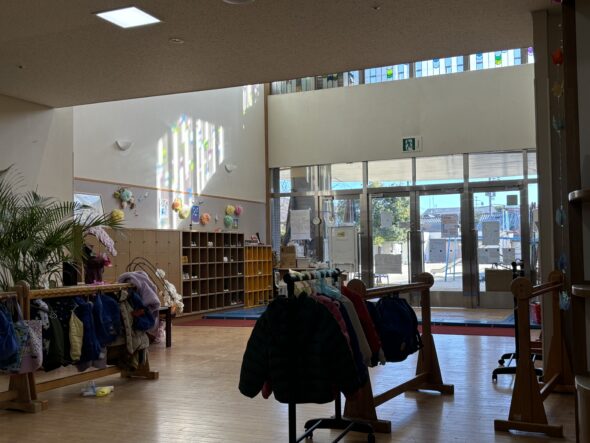
Mina Chioldi: Volunteering at Mitsuba Kindergarten

For my CIP activity I got to volunteer and play with kids at a local daycare near Doshisha University. It mostly consisted of crafts, drawing, and games, and the faculty and kids were very welcoming even though I was a foreigner with a low level of Japanese.

This CIP was not a big time commitment and did not give me a lot of responsibilities, so I would recommend it if you generally like kids. They were very well behaved and cute, so I found it stress relieving to go each week and not focus on my schoolwork. I think that you would get more out of it if you had a higher level of Japanese, but it’s possible either way.

Andrew Feenstra: Kyudo

For my CIP, I decided to do Kyudo at the Kyoto City Budo Center. There are a lot of things to remember each week, such as proper etiquette, proper form, etc., but once you get it down it feels insanely rewarding. The sensei at the dojo was super friendly and was very accommodating despite the language barrier. At the end, I felt extremely comfortable using the huge bow and was able to hit the target almost in the center! My advice to incoming students would be that you should not hesitate to make more friends at the dojo! It can be intimidating, but it can make your experience a lot more meaningful and improve your Japanese tenfold.